

Palm Springs' Historic Tennis Club neighborhood is one of the city's best places to experience its early history, historic architecture and resort culture on foot. Located just south of downtown, the neighborhood combines historic homes, boutique hotels, restaurants and some of the city's most interesting examples of early Palm Springs architecture.
The neighborhood began taking shape in the 1920s, when Palm Springs pioneer Pearl McCallum McManus subdivided Tahquitz Park. Over the decades, it became home to influential residents, historic resorts, and the Palm Springs Tennis Club, which gave the neighborhood its name.
Today, you can explore the neighborhood at your own pace, taking in historic buildings and architectural details along quiet residential streets.
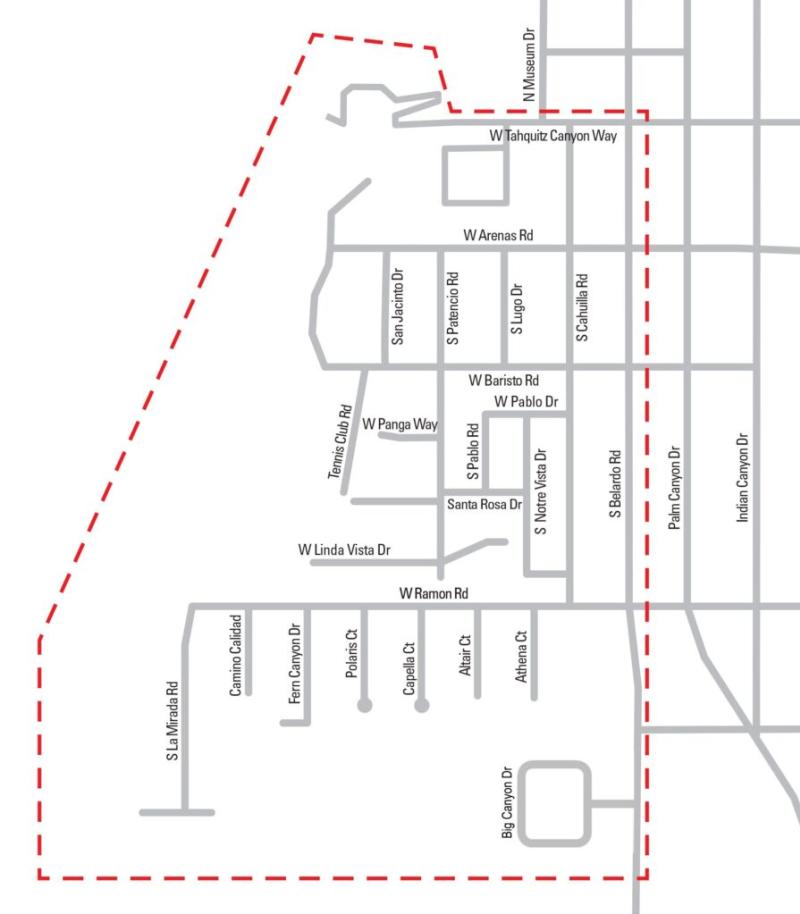
Before You Go
Distance: Approximately 2 miles
Time: Allow 1½ to 2 hours, depending on how long you spend at each stop
Difficulty: Easy, but you'll be walking outdoors in the desert
Parking: Free public parking is available on North Museum Drive across from the Palm Springs Art Museum, along with some free street parking.
Best time to walk: Fall, winter, and spring mornings or late afternoons are the most comfortable. In warmer months, start early and bring water, sunscreen, and a hat.
Please remember: Many of the homes on this tour are privately owned. Enjoy the architecture from public sidewalks and respect residents' privacy.
A Neighborhood Built by Pearl McCallum McManus
The story of the Historic Tennis Club neighborhood begins with Pearl McCallum McManus, daughter of Palm Springs pioneer John Guthrie McCallum.
In 1923, McManus subdivided Tahquitz Park, creating one of Palm Springs' earliest residential developments. She also developed the Palm Springs Tennis Club, which opened in 1937 and eventually became the namesake for the surrounding neighborhood.
The neighborhood evolved from a collection of early residences and small resorts into a showcase of Palm Springs architecture, with buildings representing Spanish Colonial Revival, Mediterranean Revival, Moderne, and midcentury modern styles.
Learn more about John McManus: John Guthrie McCallum and the First Non‑Native Settlement
Start Your Tour
Begin at North Museum Drive, near the Palm Springs Art Museum. From here, walk south toward the Historic Tennis Club neighborhood.
Stop 1: Le Vallauris
385 W Tahquitz
One of the neighborhood's most recognizable historic properties is now home to Le Vallauris, a longtime Palm Springs restaurant.
Palm Springs architect Herbert Burns designed the house in 1951 for George Roberson, son of Nellie Coffman, the founder of the Desert Inn. Burns designed the residence in a style that reflected the romantic, Old California character found throughout early Palm Springs.
Take a moment to look at the property's walls, landscaping, and architectural details before continuing north along South Patencio Road.
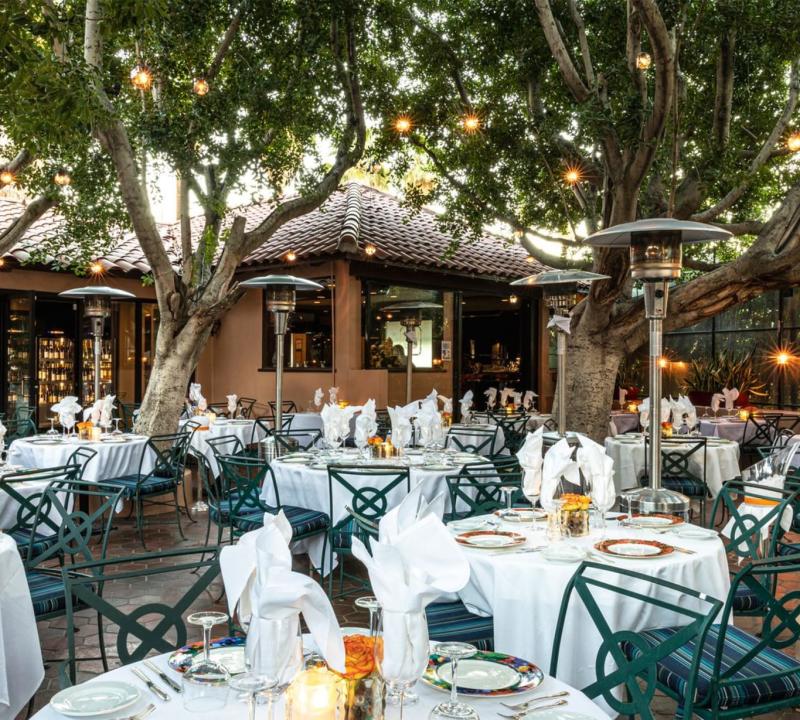
Stop 2: The Willows Palm Springs Historic Inn
412 W Tahquitz Canyon Way
The Willows was built in 1925 as the winter home of businessman William Mead, designed by architect William Dodd of Dodd & Richards. This land was notable for the Tahquitz Creek running through it and the abundance of willow trees. Although not widely known today, Mead was a significant community figure with wealth from real estate and fire insurance, who later founded the Central State Bank.
Samuel Untermeyer, a renowned New York lawyer, purchased The Willows in 1930 following William Mead's death. Untermeyer made several modifications to the property, including enclosing a patio and adding a box-beam ceiling with painted panels. He expanded the gardens and added a pool, transforming the property into a tropical oasis. During the rise of Nazi Germany, Untermeyer invited Albert Einstein to stay at his Palm Springs home.
👉 Discovering Palm Springs' Iconic Historic Hotels
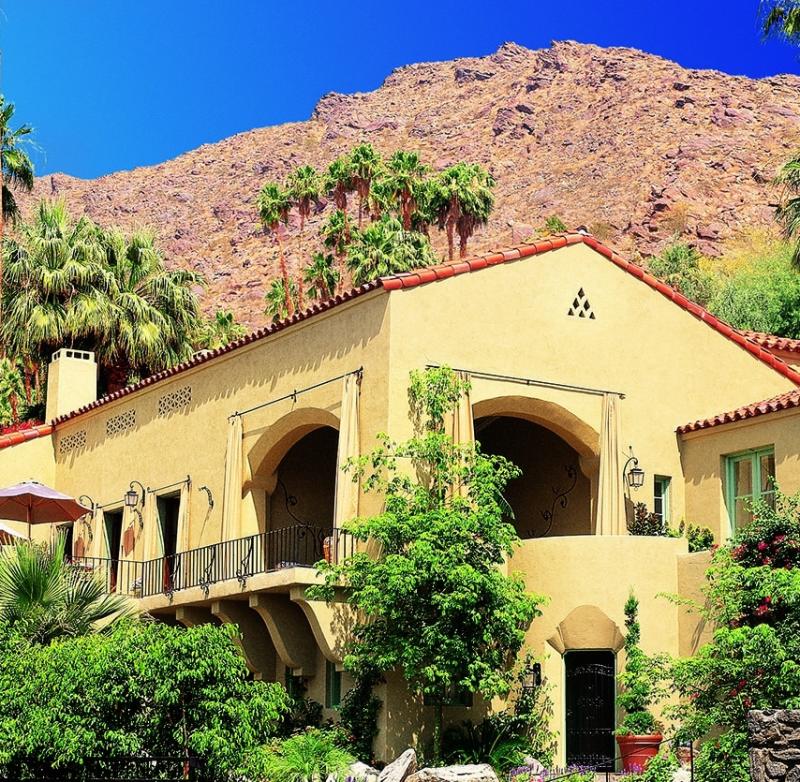
Head to the corner of W. Tahquitz Canyon Way and S Cahuilla Road. Palm Mountain Resort & Spa will be on your left.
Head south on S. Cahuilla Rd. Casa Cody will be on your right, the last property on the block.
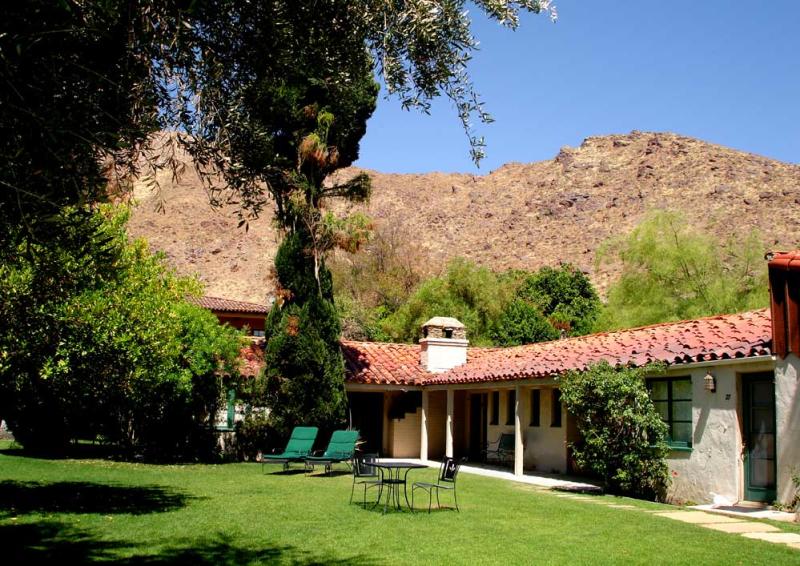
Stop 3: Casa Cody
175 S Cahuilla Road
In 1916, Herold and Harriet Cody moved from Hollywood to Palm Springs for Herold's health, seeking relief in the desert air. Herold, an architect in Los Angeles, was related to Buffalo Bill Cody and had worked on Riverside's Mission Inn. Harriet, from a wealthy Philadelphia family and descended from Sir Thomas Moore, met Nellie Coffman at the Desert Inn.
They lived off the rent from their Hollywood home but faced financial issues when tenants defaulted. Harriet traded their Hollywood house for 80 acres in Palm Springs and started a stable to make ends meet. Despite Harold's passing in 1924, Harriet expanded the stable business and eventually built Casa Cody in 1937, now the oldest continuously operating hotel in Palm Springs.
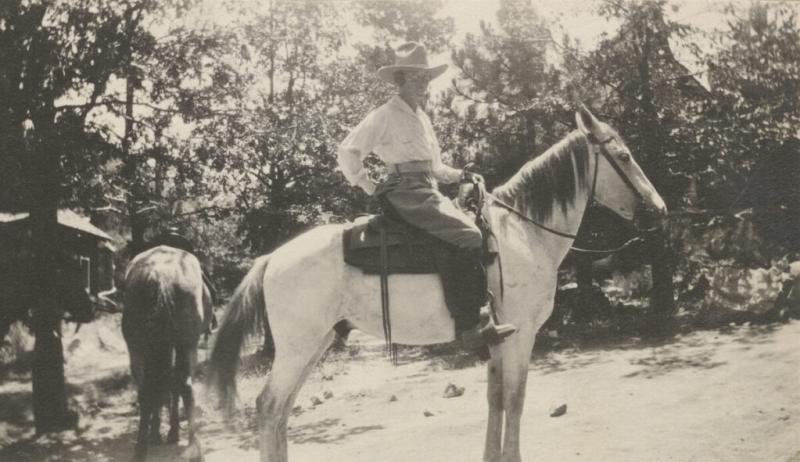
Harriet Cody
At the end of the block, turn left on W Arenas Rd. Holiday House will be on the corner of W Arenas Rd. and S Belardo Rd.
Stop 4: Holiday House
200 W. Arenas Road
Lloyd Whaley opened Holiday House in 1951. He had visited Palm Springs with his family since the early 40s. Whaley is credited with building and developing over 5,000 homes in Long Beach and 2,000 in his University City subdivision near the coast. Architectural designer Herbert W. Burns designed the hotel. The hotel boasted a heated swimming pool, greens, shuffleboard games, an outdoor cabana for day and night functions, bicycles for tenants, and other recreational facilities. It was designed to be an extended-stay hotel.
It was initially built as a single story, and a second story was added in 1962. The owners of Sparrows Lodge bought the property and put it on a fast track to a total transformation. In 2017, the 28-room Holiday House reopened with its original name and spirit. For the reboot, they enlisted L.A.-based designer Mark Sikes, who married midcentury modern elements with touches of whimsy, like cornflower-patterned bedspreads and ceramic monkeys, to accent countertops in the white-tiled bathrooms. The pool has been completely redone, while the shuffleboard court is original.

Head south on S Belardo one block to the corner of Baristo. Del Marcos Hotel will be on the south corner.
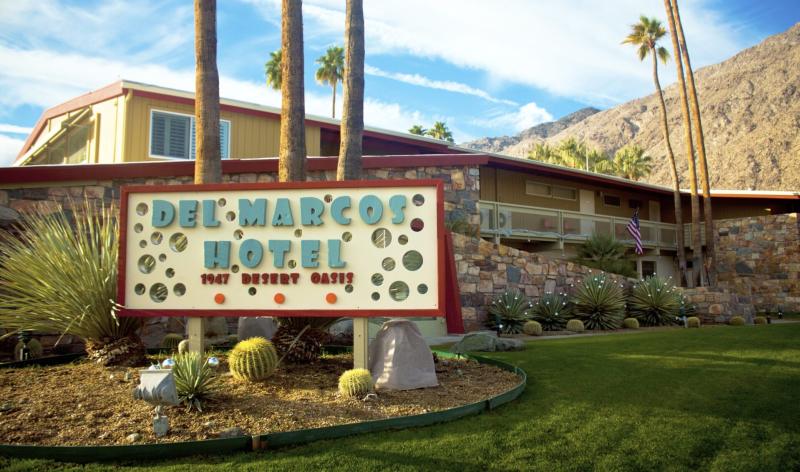
Stop 5: Del Marcos Hotel
225 W Baristo Road
Owners Samual and Adele Marcus hired architect William Cody to build the handsome Del Marcos Hotel in 1947. This was Cody's first commission, and it launched his career in Palm Springs. He was a prominent architect whose visionary work in Palm Springs during the mid-20th century helped shape the city's iconic modernist landscape. Known for his minimalist and sleek designs, Cody blended indoor and outdoor spaces seamlessly, creating elegant structures that harmonize with the desert surroundings. Del Marcos Hotel set the tone for his career by showcasing bold lines and a harmonious connection to the natural environment. Cody's architectural legacy in Palm Springs includes residences, hotels, and commercial buildings, all characterized by their open layouts, clean lines, and integration of the desert landscape, making him a key figure in Desert Modernism.
The hotel has 16 rooms, and no two rooms are alike. Carefully designed furniture created a feeling of spaciousness, placed to provide maximum freedom of movement. It was, and is, an indoor-outdoor way of living, with substantial window areas overlooking Palm Springs' beautiful vistas, a feature typical of William Cody's designs.
A Class 1 historic site designation of the Del Marcos Hotel was made official on May 2, 2012.
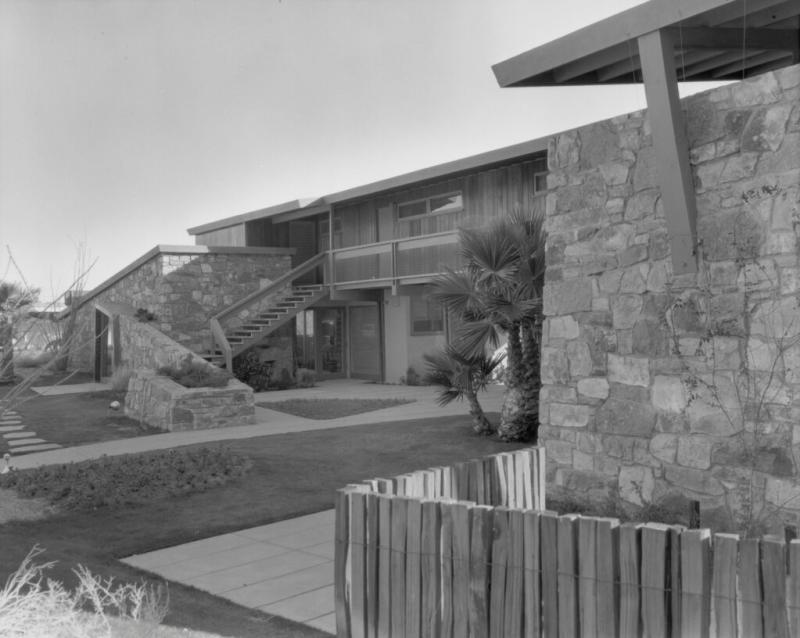
Julius Shulman photography archive, 1936-1997.
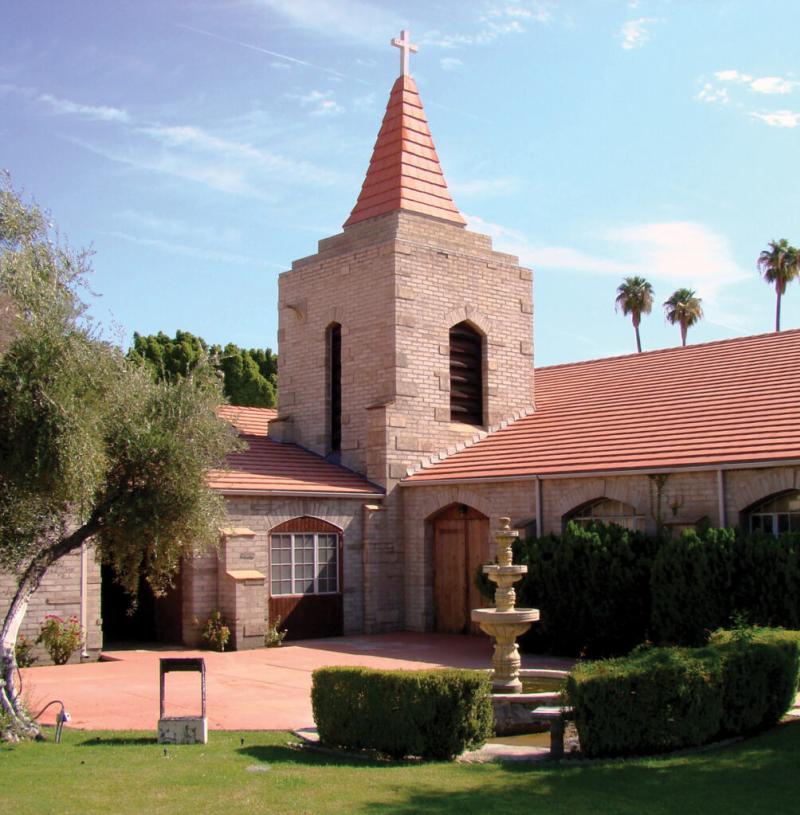
Across the street from the Del Marcos Hotel is the old Community Church.
Stop 6: Community Church of Palm Springs
284 S Cahuilla Road
Charles Tanner built it in 1936, and Williams, Williams, & Williams designed alterations in 1947 and 1952. On February 21, 1954, President and Mrs. Eisenhower worshipped here during a week-long visit to Palm Springs. The church was extensively damaged by fire in 2013.
The damaged building site next to the church was known as the Orchid Tree Inn. It consisted of seven buildings built between 1915 and 1948, which were developed over time by multiple owners. The property comprised a variety of building types, including a Craftsman bungalow (destroyed by fire), a two-story apartment building designed by Albert Frey (recently destroyed by fire), two one-story apartment buildings, a small Spanish-style duplex, a one-story motel complex, a four-unit apartment, and a courtyard motel.
Next to Del Marcos, at the corner of S Cahuilla Rd, is the Women's Club.
Stop 7: Palm Springs Women's Club
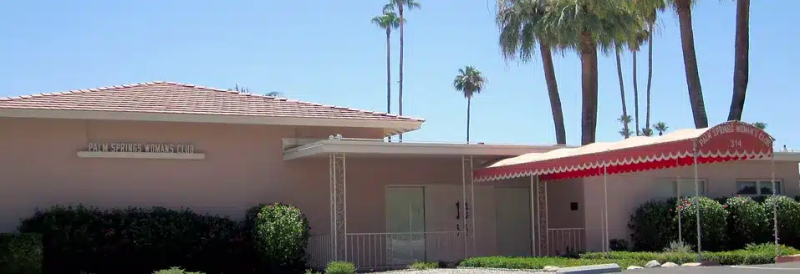
314 S Cahuilla Rd
Pearl McCallum McManus, daughter of pioneer J.G. McCallum, married real estate mogul Austin G. McManus and became a skilled land trader. She donated land for the Palm Springs Women's Club (PSWC) and contributed significantly to the community. To continue her charitable work, she founded the McCallum Desert Foundation in memory of her father. This foundation supported PSWC with grants.
John Porter Clark designed the PSWC clubhouse, which was dedicated in 1939. This clubhouse exemplifies early California modernism, which later influenced midcentury architecture in Palm Springs by architects like Albert Frey and Richard Neutra. The clubhouse is a key feature of the historic Tennis Club neighborhood, also created by Pearl McManus, and attracts architecture enthusiasts.
The building is a good reminder that Palm Springs' history isn't only about celebrities and resorts. Community organizations helped shape the city, too.
Head back to Belardo and continue south. You will first come to La Serena Villas, then the Avalon Hotel & Bungalows, and last on the west side of the block, Ingleside Estate.
Stop 8: La Serena Villas
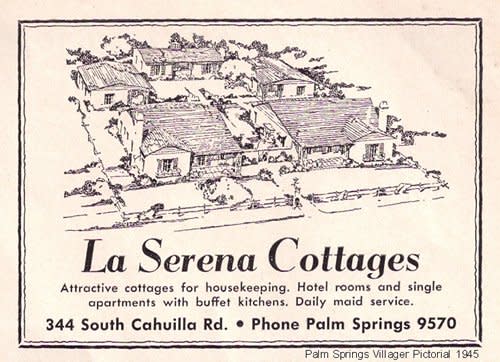
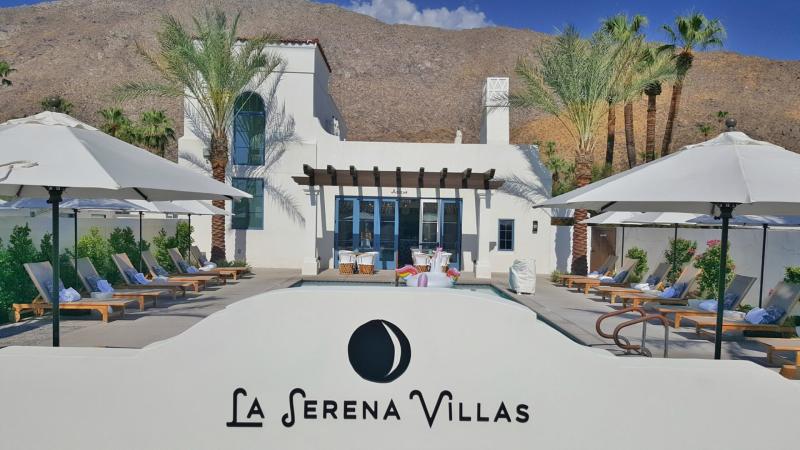
339 S. Belardo Road
Frank Pershing had just opened Estrella Villas in 1933 (Avalon, next stop) and then built La Serena Cottages as bungalows and apartments. He went into business with Mr. Oucault, the famous cartoonist and originator of Buster Brown cartoons, and was also his brother-in-law. Brewster, Benedict, and Taylor were the architects, and Atkin & Marsh were the builders. Frank became a council member in 1938.
Las Serena Villas was badly damaged, and May Sung, the co-founder of SUBU Design Architecture of Los Angeles, reimagined it. The bungalows were rebuilt on the same footprint they originally occupied, but with more modern amenities and larger bathrooms. The restoration project cost $10 million. New amenities include a Mediterranean tapas restaurant, Azucar, with a rooftop deck overlooking Mount San Jacinto. Two of the units are designed as one-bedroom suites with kitchens.
Stop 9: Avalon Hotel & Bungalows
415 S. Belardo Road
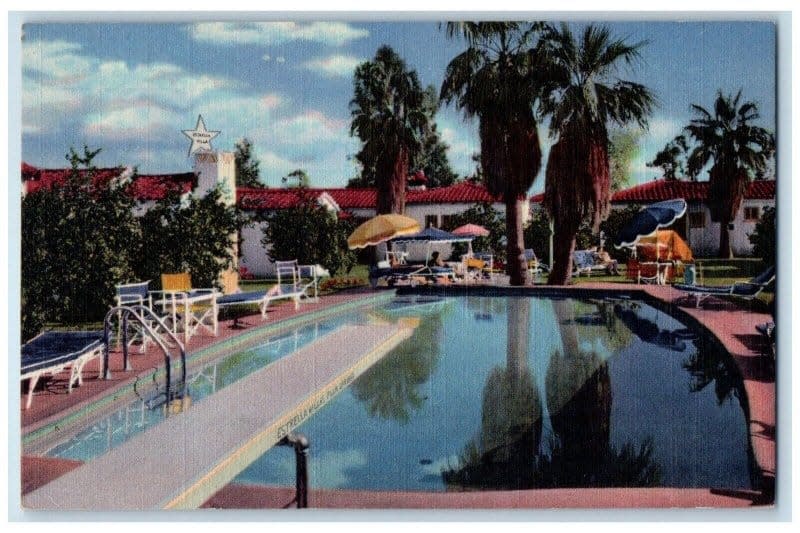
The Estrella Villas (Avalon), which opened in 1933, was considered one of the swankiest apartment courts in the village. Jackie Cooper and his mother were guests at Estrella Villas in April 1939. Jackie had a few days off between his new picture, "What a Life." Bing Crosby and his wife, Dixie Lee, were also guests that same year. In 1941, Judy Garland enjoyed a few weeks at Estrella Villas. She was there with her mother and her girlfriend, Betty Graham.
The Estrella was restored to that era's original charm and elegance in 1996, boasting 62 beautifully appointed deluxe guest rooms, suites, and private villas with fully equipped kitchens and fireplaces.
It was completely revamped in 2002. New additions included the Estrella Spa and the restaurant Citron (now Chi Chi). As a result, Conde Nast Traveler selected the property as one of the 80 best new hotels in the world, placing it on the 2003 "Hot List."
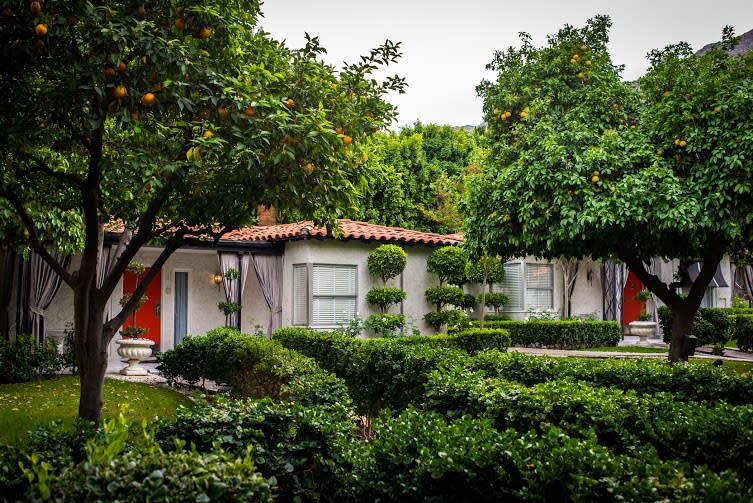
Stop 10: Ingleside Estate
200 W Ramon Rd
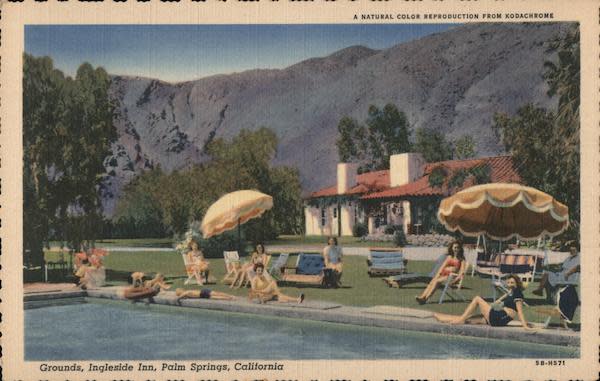
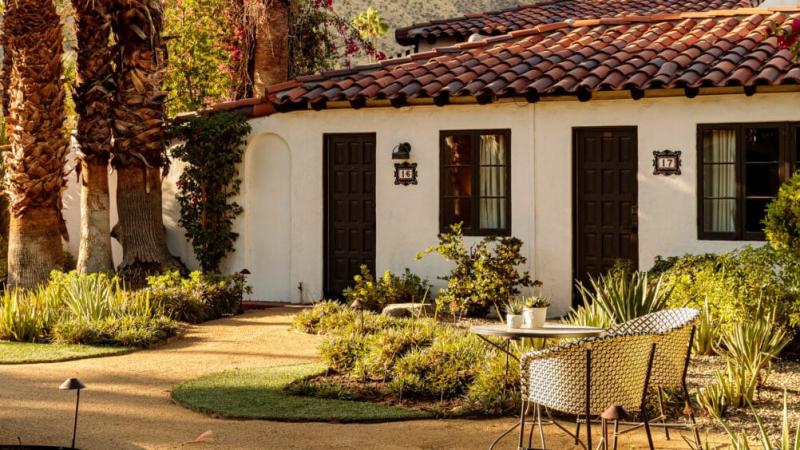
Jackson and Ruth Hardy purchased the property in 1940 and transformed it into a luxury hotel. The 32 rooms had been remodeled, and they kept the home's antique furnishings. Each guest room had a fireplace and French doors that opened onto the gardens.
Stars such as Lily Pons, a famous operatic star, were frequent visitors and ended up taking over a villa for 13 years. Charles Laughton, Ava Gardner, Rita Hayworth, Gary Cooper, Salvador Dali, the elusive Howard Hughes, Lucille Ball, Bette Midler, Frank Sinatra, Debbie Reynolds, Xavier Cugat, Jackie Coogan, Kay Ballard, Yogi Berra, John Florsheim, and Jolie Gabor were all guests. The list goes on and on.
The Ingleside Estate now has 30 rooms, suites, and villas.
Turn right at W. Ramon Rd, go one block, and turn right again at S. Cahuilla Rd.
Take the first left on W Monte Vista Dr, which will curve into S Monte Vista Dr.
Continue north to the first street on the left, Santa Rosa Dr. The Alshuler residence will be the first house on your left.
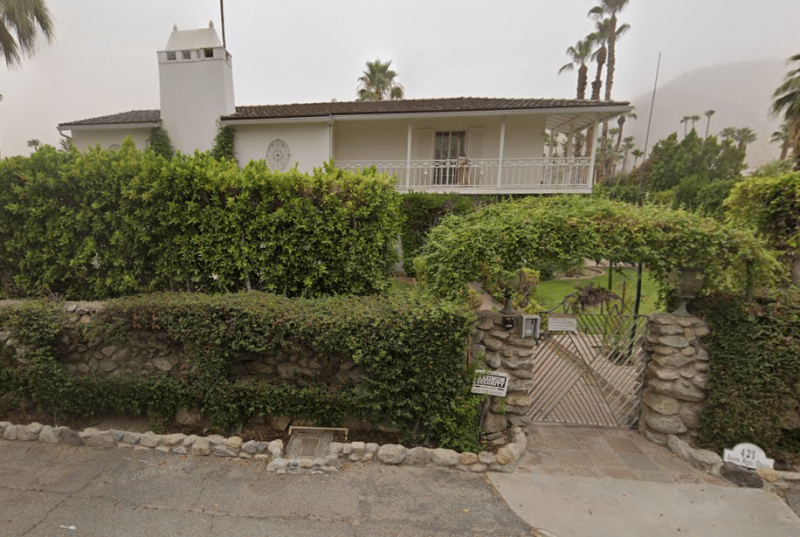
Stop 11: Ernest Alshuler Residence
421 Santa Rosa Dr.
The original home was built in 1939 for Katherine Romer and designed by F. Nelson Breed. Albert Frey and John Porter Clark added an addition in 1950 for Alshuler. It was sold in 1954 and is believed to have been remodeled by E. Steward Williams in 1954. Alshuler was the President of Sentinel Radio Corporation, a well-known Chicago-based radio manufacturer. He was heavily involved in creating the first Community Hospital, which is now Desert Regional, and was named President of the Hospital Association in 1949. He was also on the Desert Museum board, later called the Palm Springs Art Museum.
The Houseman Residence is two houses down on the left.
Stop 12: George Houseman Residence
416 S Patencio Rd
George was a winter visitor to Palm Springs since 1925. He was an active developer in Portland, Oregon. He built the Barbara Hotel in Los Angeles, which boxer Jack Dempsey owned. In 1938, he purchased this residence. He served on the City Council from 1942 to 1944.
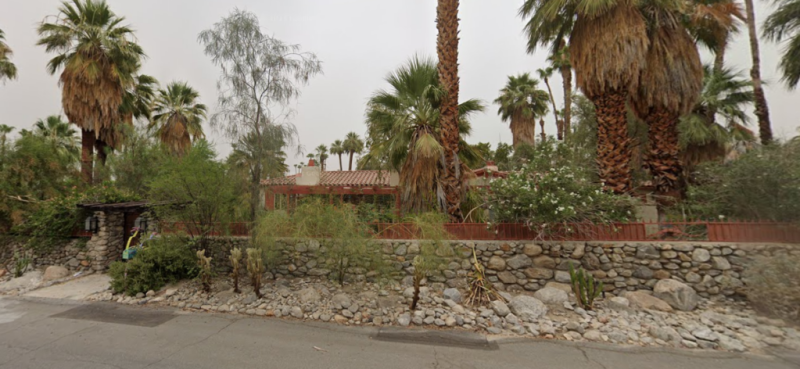
Continue on Santa Rosa Dr toward the mountains. There will be a jog in the road crossing over S Patencio Rd, and the Peake residence will be at the corner on the left.
Stop 13: Peake Residence
501 Santa Rosa Dr
Will and Wanda Peake built this home in 1940. Will lived in the house until his passing in 1963. They had been visiting Palm Springs since 1925. He was chairman of the board of Consolidated Freight Lines, one of the largest trucking companies at the time. It was founded in 1929 in Portland, Oregon. At its height, the company had over 15,000 employees.
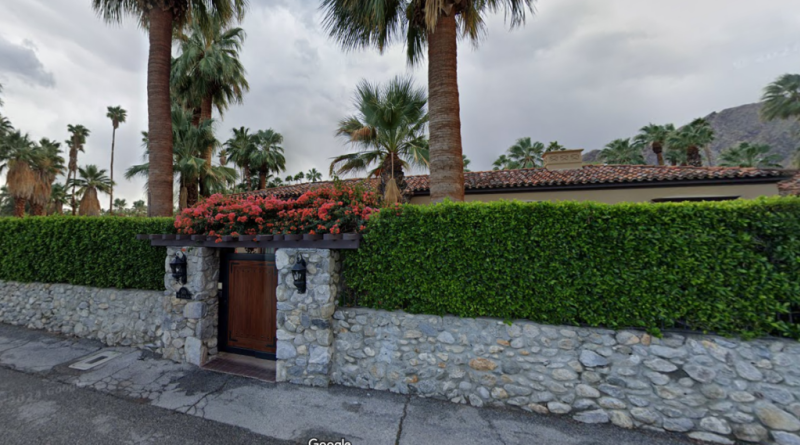
Next to the Peak Residence on S Patencio Rd. is the Gould Residence
Stop 14: Ray Gould Residence
475 S Patencio Road
Gladys and Ray Gould built this home in 1956. Records show a pool permit was issued in January. It has a circular curve drive, and the house wraps around the pool. Ray passed away in 1968, still owning this property. He was a pioneer automobile dealer (Chrysler) for 50 years in Beverly Hills and Long Beach. The rooms are shaped as pie wedges joined in the center.
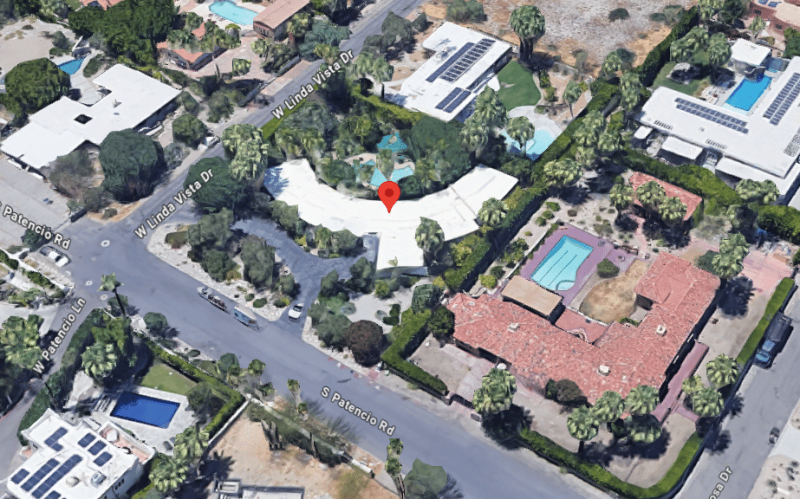
The Bourne residence will be on the opposite corner at S Patencio Rd and W Patencio Lane, where S Patencio Rd ends.
Stop 15: Arthur K Bourne Residence
486 W Patencio Lane
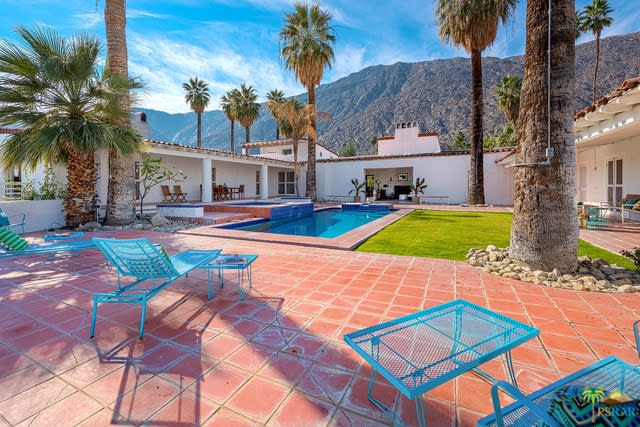
Walter Neff designed this residence in 1933 for a wealthy playboy and heir to the Singer Sewing fortune. The home features classic elements of California's golden age architecture, including Moorish influences and a spacious, inviting layout. This 9,318 square-foot home has 10 bedrooms, 11 bathrooms, and sits on over an acre. Walter built houses for some of the wealthiest and most famous clients, including King Gillette, Darryl Zanuck, Charles Chaplin, Mary Pickford, Harpo Marx, and Red Skelton, to name a few.
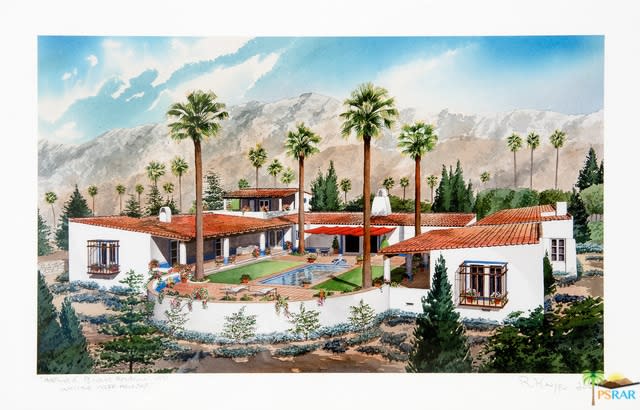
Head up W Linda Vista Drive, and the Crockett residence will be the second home on your right.
Stop 16: Merrill Crockett Residence
590 W Linda Vista Drive
Merrill and Juanita Crockett commissioned this residence in 1932. He owned the popular Village Pharmacy. They purchased the land from Pearl McManus in 1949, the owner and developer of the Tennis Club. Herbert Burns designed this 2,350-square-foot residence with three bedrooms and two baths in 1951. He styled this like several other buildings in the Tennis Club neighborhood in an "Old West" aesthetic. The concrete wall was added in 2005.
Former Palm Springs City Councilman and architect Chris Mills is Crockett's grandson.
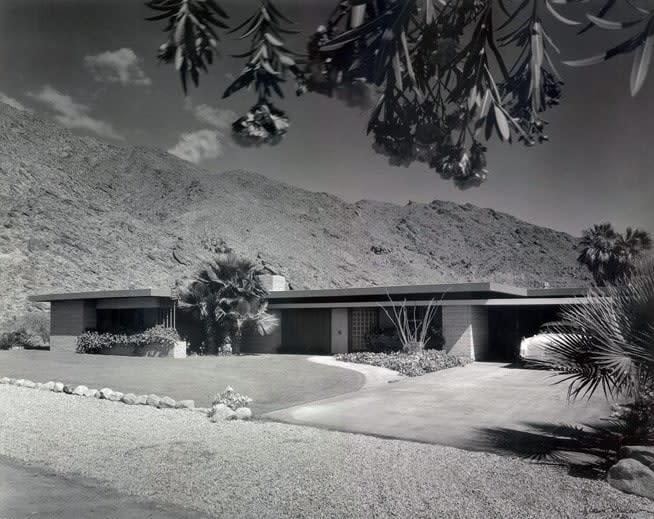
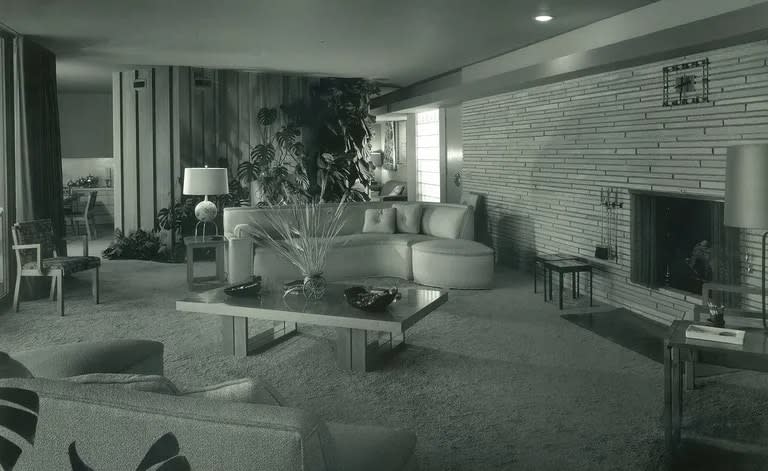
Crockett Residence, 1951. J. Paul Getty Trust, Getty Research Institute, Los Angeles (2004.R.10)
Head back to S. Patencio Rd. and continue north.
Stop 17
395 S Patencio Rd
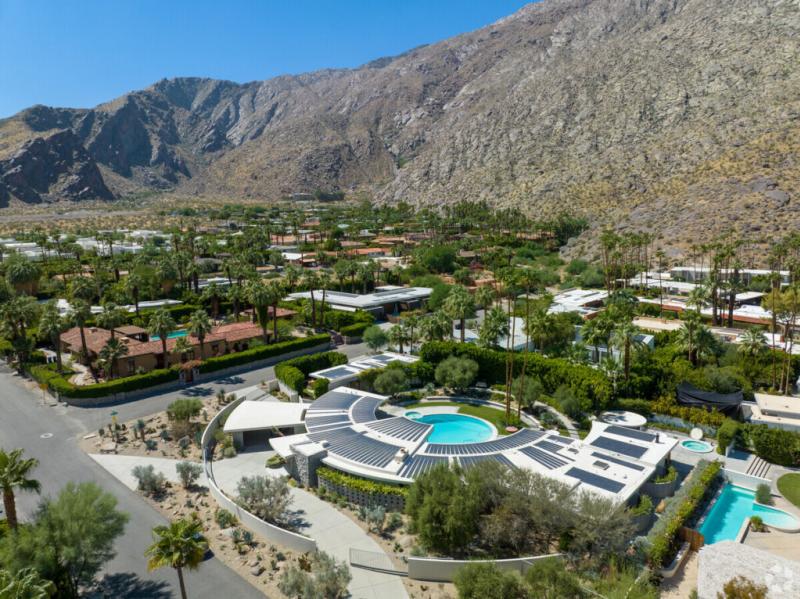
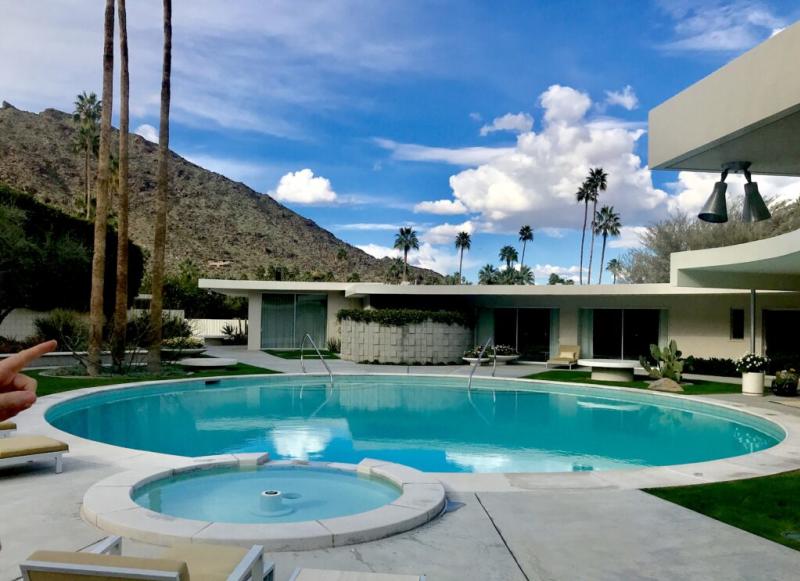
This residence sits on a double lot (.69 acres). It was originally designed in 1962 by Richard Wheeler, a San Diego architect who designed the corporate headquarters of San Diego Gas & Electric in 1968. In 1978, Albert Frey added a master suite and a guest house/garage. The unique curved architecture embraces the panoramic, unobstructed mountain views and invites you outside to the round pool and abundant grounds.
Continue north past W Panga Way, and the Abernathy residence will be on your right.
Stop 18: Madge Phillips Abernathy Residence
310 S Patencio Rd
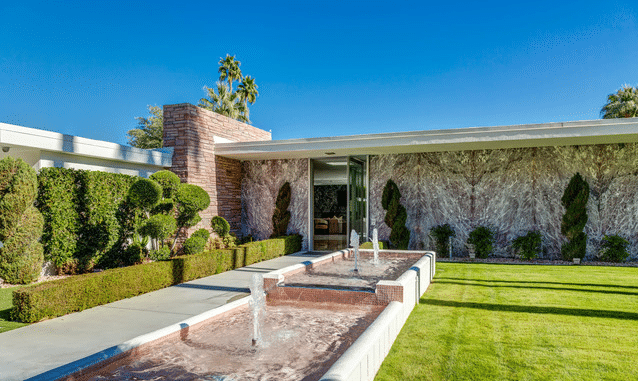
Herbert Burns designed the residence in 1959 for Madge Phillips Abernathy. It was sold to David and Hope Hearst in 1962. David was the son of William Randolph Hearst. She was also friends with Rosalie and George Hearst, the eldest son, who also owned a home in the area. Madge was a prominent Palm Springs civic and social leader and a distinguished artist.
Continue and turn left at W Baristo Rd. The Four Seasons is on the north corner of Baristo and San Jacinto Dr.
Stop 19: The Four Seasons Apartment Hotel
290 San Jacinto Dr
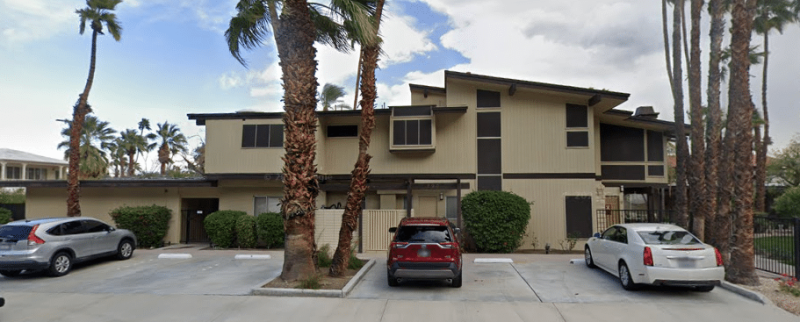
On the corner of San Jacinto Drive and Baristo. This apartment complex was built in 1962 and designed by Herbert Burns. There are 24 units.
Head to the end of W Baristo, and you will come to Spencer's Restaurant.
Stop 20: Palm Springs Tennis Club
701 W Baristo Rd
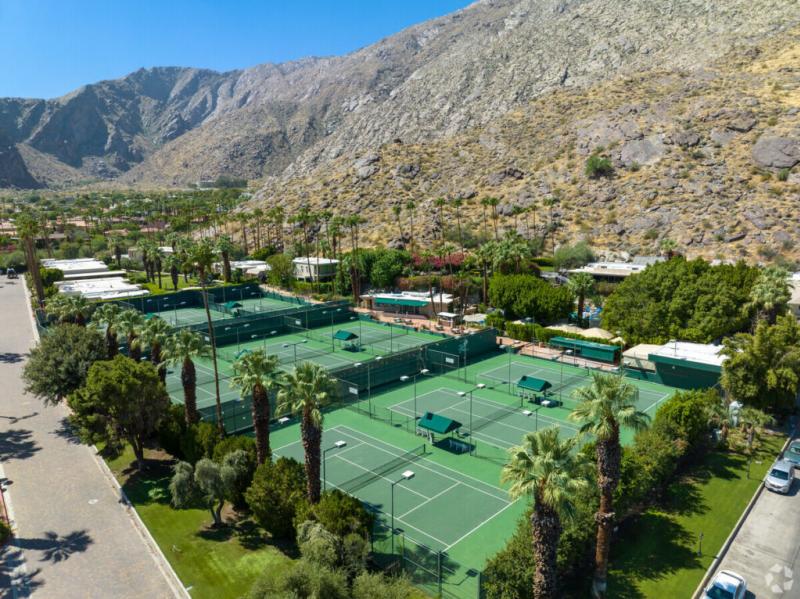
The Palm Springs Tennis Club, built by Pearl McManus in 1937, featured two tennis courts and the most photographed pool in the West. When they were installed, the tennis courts were considered to be the best in the world. The swimming pool that followed, with its landscaping, including V-shaped palm trees, became a model for resort pools for years. The clubhouse opened in 1938 and was designed by Los Angeles architect Paul Williams, the first black American Institute of Architects member. The original club building has undergone extensive expansion.
The Tennis Club hosted many fashion shows. For example, in 1954, movie stars in the fashion show audience included Mitzi Gaynor, Terry Moore, Debbie Reynolds, Susan Zanuck, Ann Francis, and Jane Powell.
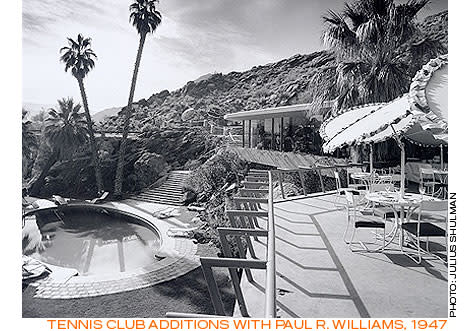
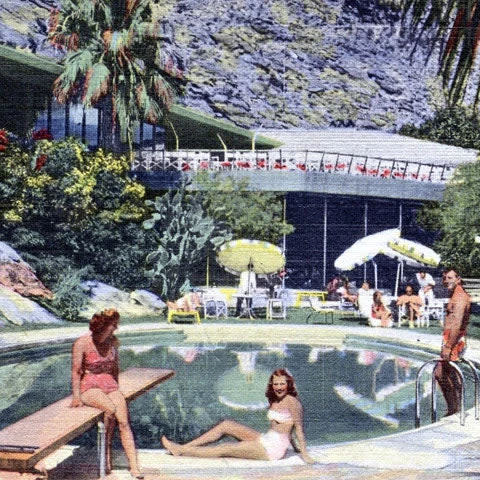
Turn right onto S Tahquitz Dr. until you come to a gate at the corner of W Arenas Rd.
Stop 21: Colony 29
147 S Tahquitz Dr
Development of the subject property began around 1926 when renowned impressionist painter Alson Clark constructed the first two buildings at 139 and 141 S Tahquitz Dr.
In 1929, John Burnham commissioned the construction of 147 S. Tahquitz Dr. He was the son of Chicago architect Daniel Burnham. His father was famous as the supervising architect of the Chicago World's Fair. John was a banker and investor who founded the nationwide investment firm Burnham & Co. He was also an amateur painter and a patron of the arts. Burnham retired in 1924 and, shortly after, began spending winters in the desert. He commissioned architect H. Palmer Sabin to design a Spanish-style estate. It was called the "Street of Spain" for its European-style architecture. The estate included a guest house and three bungalows for his painter friends. It now consists of 6 homes. Few houses existed in this neighborhood at the time.
John Burnham later co-founded the Desert Art School with Pearl McManus, housed in the old McCallum adobe. In 1954, he sold the main house and two bungalows to Francis Crocker, who developed the Palm Springs Aerial Tramway. However, the site remained an artist colony until the 1970s. It was later sold, renovated, and called Colony 29, a vacation rental and event space. SOHO House currently owns it.
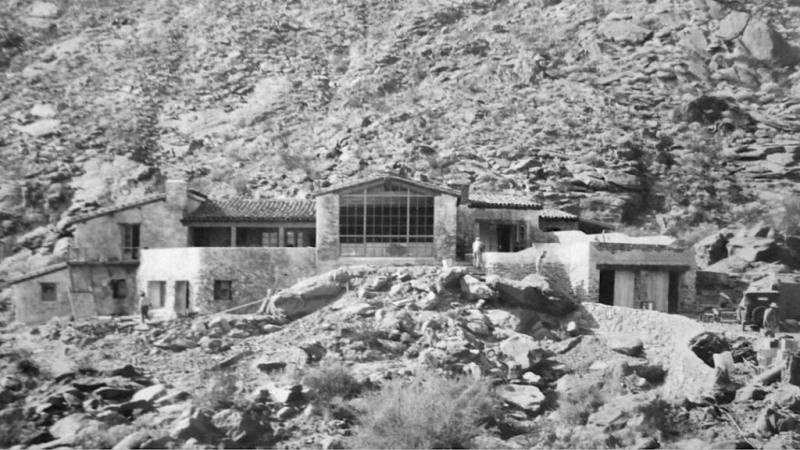
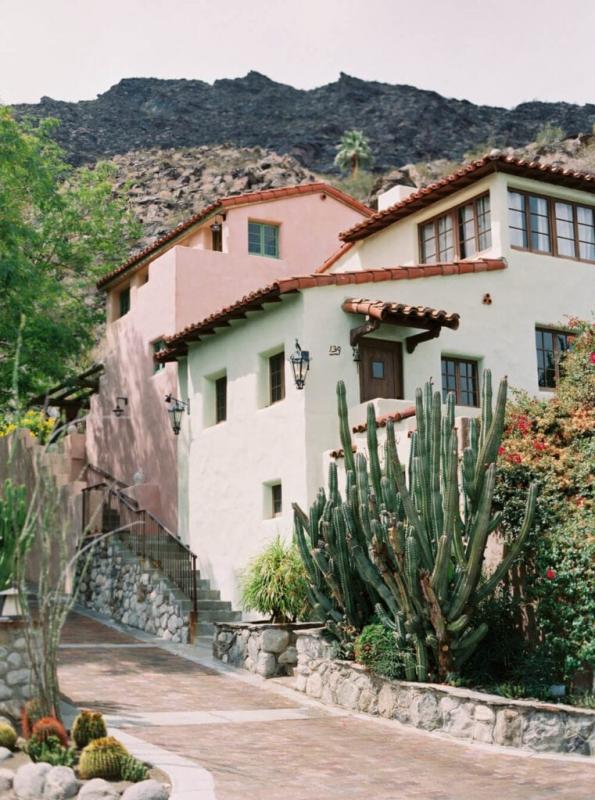
Head east on W Arenas Rd. Desert Hills Hotel is on the south corner of San Jacinto Dr.
Stop 22: Desert Hills Apartment Hotel
601 W Arenas Road
Herbert W. Burns designed this 14-unit complex designed in 1956 for Allen and Joanne Petty. With its classic coral pink signage on weathered brown board-and-batten, it is where Doris Day used to stay. The Desert Hills is now a boutique hotel.
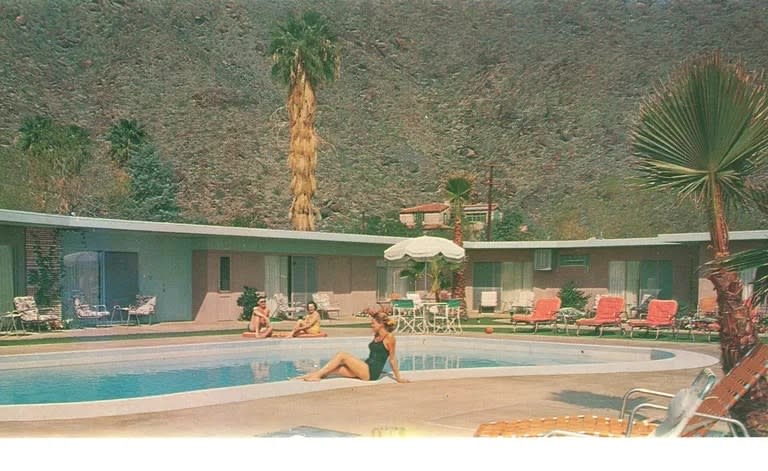
Vintage postcard, Desert Hills Apartment Hotel, Arenas Road, 1956
Orbit In is across the street, just past San Jacinto Dr on the left.
Stop 23: Orbit In
562 W Arenas Road
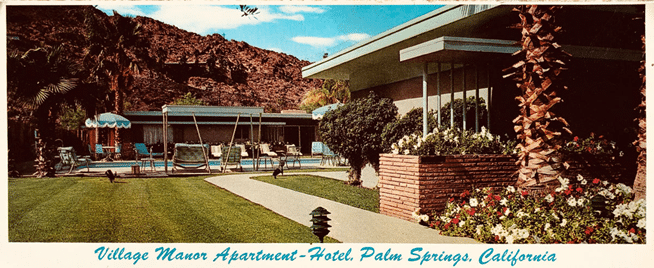
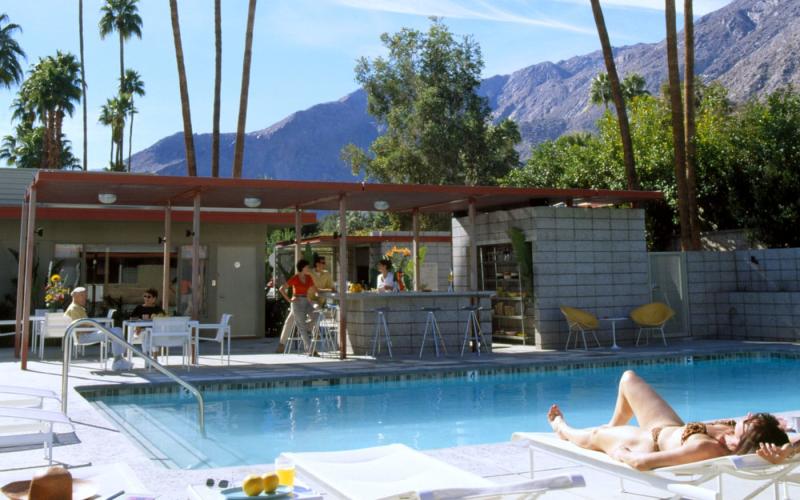
Herbert W. Burns designed the Orbit In in 1955, and it opened as Village Manor Apartment Hotel. He purchased the land in 1949 and sold it in 1955, once it was completed. It is an important intact example of a commercial desert modernist hotel structure from the midcentury modern period. He designed at least a dozen commercial buildings and over two dozen residential or private buildings here in the desert.
It has 9 studio-style units, each with a private rear patio and most retaining the original pink-tiled bathroom. It was originally built with five rental units, each with a separate kitchen, and a large owner's unit with a guest room, kitchen, and small office. The building has been modified but is essentially unchanged. The units surround a courtyard with a large pool and an outdoor covered bar addition.
Just down from Orbit in.
Stop 24: The 500 West
500 West Arenas Road
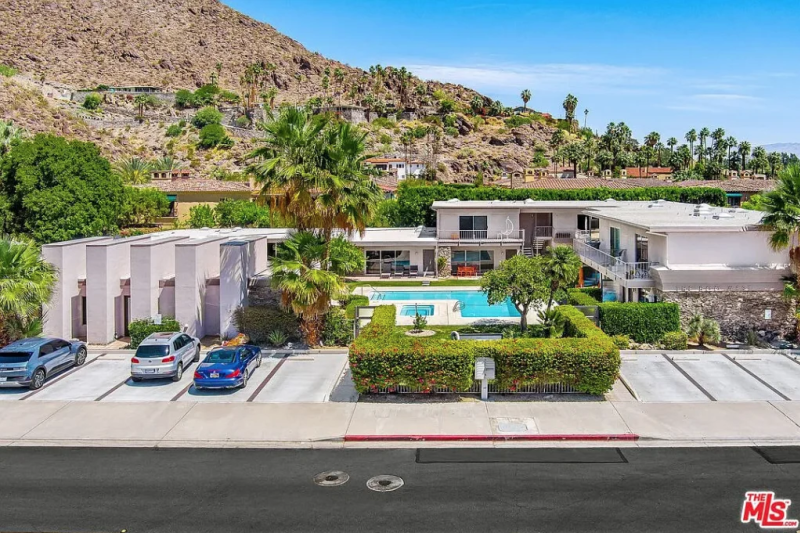
Designed by Herbert Burns in 1970, this is now an exclusive 10-unit condo.
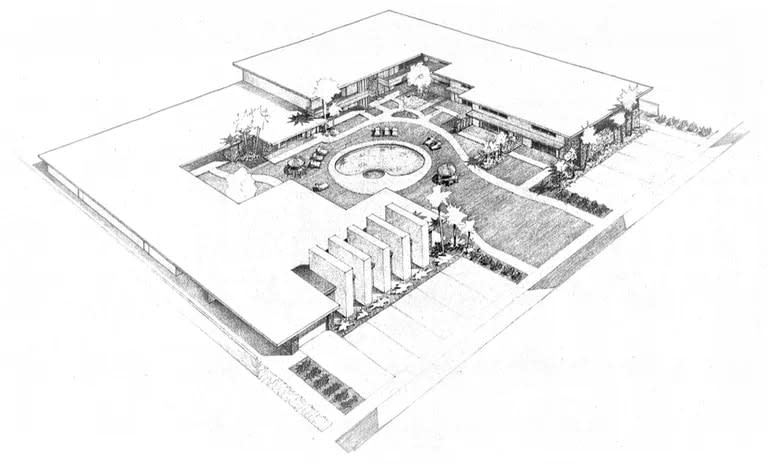
Gloria Palm Springs is across the street.
Stop 25: Gloria Palm Springs
529 W Arenas Road
Gloria Palm Springs (formerly known as Amin Casa) was built in the 1920s and 1930s. It is alleged that the property was once the home of Hollywood screen legend Gloria Swanson. Swanson, best known for her role as Norma Desmond in the film Sunset Boulevard, made this expansive property her desert retreat.
In 2015, the property was acquired and underwent extensive renovations, transforming it into the luxurious boutique hotel it is today. The renovations preserved the property's original charm and elegance while adding modern amenities and comforts. The hotel now features beautifully landscaped gardens, private bungalows, and a pool studio suite, all designed to offer a relaxing and memorable stay.
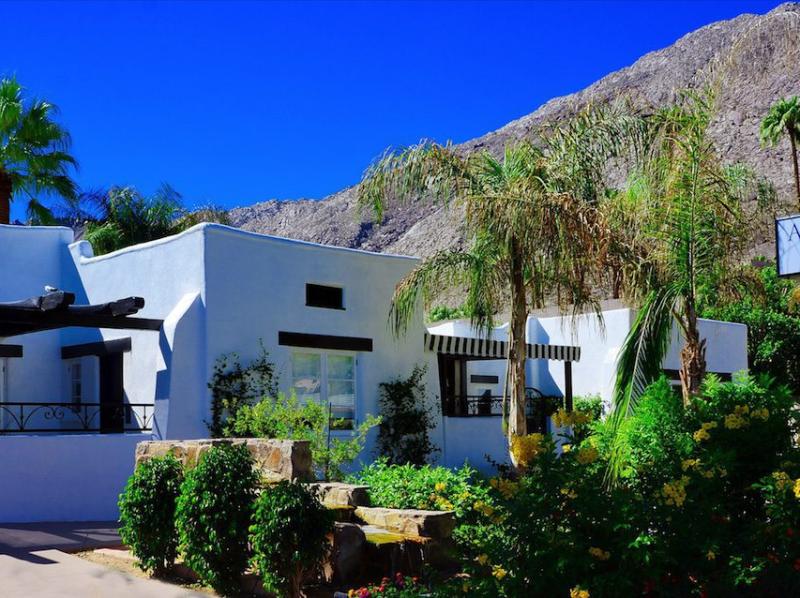
Head south on S Patencio Rd. Old Ranch Inn will be on your left.
Stop 26: Old Ranch Inn
222 S Patencio Road
The Old Ranch Inn is a charming Spanish-style boutique hotel. It offers a relaxed atmosphere and a unique blend of hospitality in the spirit of the Old West. Built in the 1930s, the hotel reflects Palm Springs' embrace of a Western theme in its architecture, décor, and outdoor activities. The hotel evokes images of cowboy culture and frontier landscapes while also blending modern luxury and sophistication. While we don't know the property's name at the time it was built, it was called the Silver Palms Hotel in the 50s.
Tom Mix was one of Hollywood's first Western stars and is closely associated with the Old Ranch Inn. A legendary figure in early cinema, Mix starred in over 290 films, most of which were silent Westerns. His daredevil stunts on screen made him a beloved figure, though they often led to serious injuries, including numerous broken bones.
Mix had filmed in Palm Springs, and in 1935, he stayed at the Old Ranch Inn with his fifth wife, Mabel Ward, whom he married in 1932. It's also said that Harriet Cody, owner of Casa Cody, rented horses to Mix for $5 a day during his time in the area.
While Mix's fame may not resonate with many, his influence on Hollywood is still felt. He helped launch the career of John Wayne, who, after a football injury sidelined him at USC, began working as a prop mover at Fox Studios—a job that Mix personally helped secure for him.
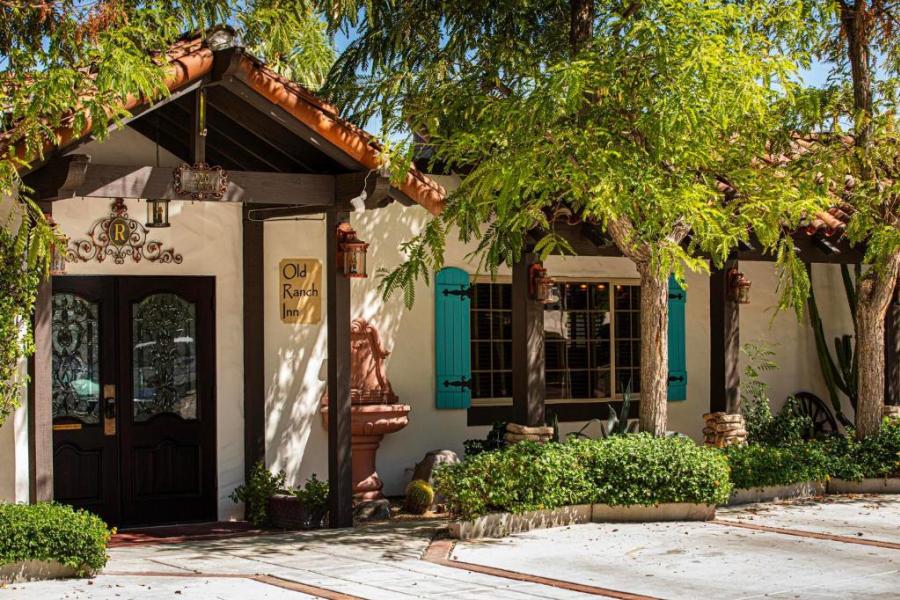
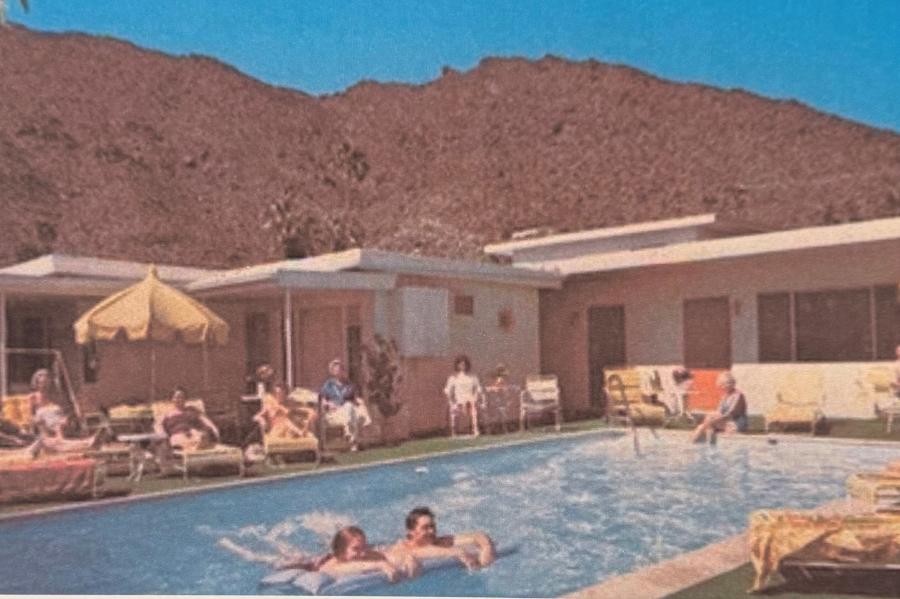
Korakia Pension will be on your right.
Stop 27: Korakia Pension
257 S Patencio Road
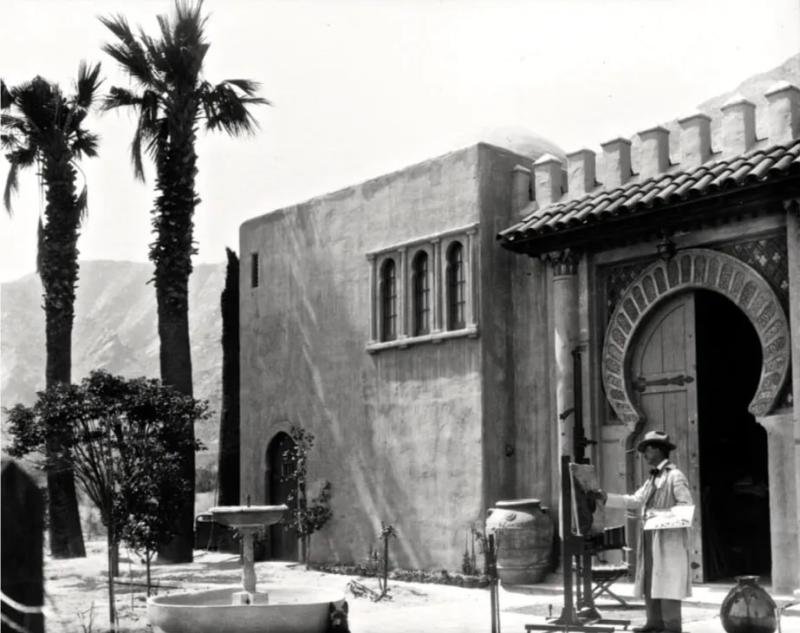
Gordon Coutts, a Scottish painter, came to Palm Springs in 1924, hoping the arid climate would help him recover from bronchial troubles. He was friends with Winston Churchill and had painted a portrait of Andrew Carnegie. After a lifetime of wandering the world, he spent his last years in Palm Springs. He studied art at the Académie Julian in Paris, where he established himself as a landscape and portrait painter. His works are hanging in the Australian National Art Gallery, the Adelaide National Gallery, and the Melbourne Art Gallery. Poor health hit him in the 1920s and brought him to Palm Springs, where a small artist colony existed at the time.
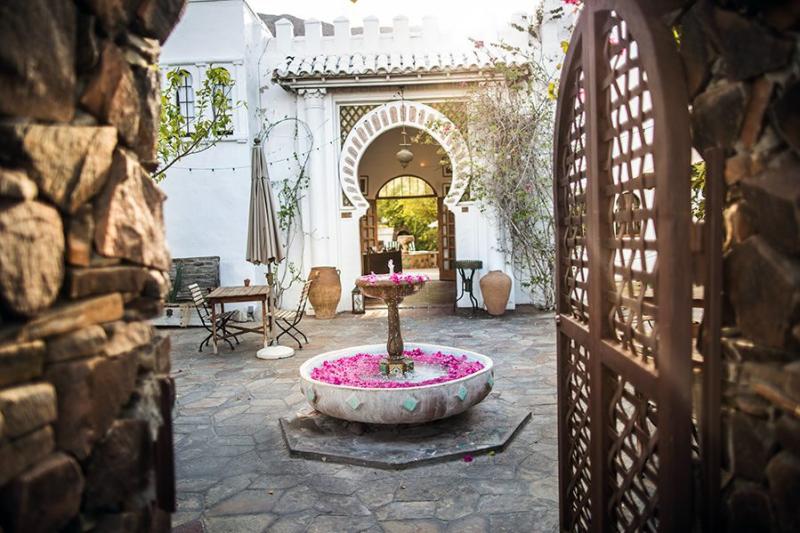
Gordon built the home in the Moroccan villa style, a rare example of Moorish Revival architecture. Originally named Dar Maroc, Korakia Pension drew on his experiences in Tangier and incorporated elements of North Africa and Morocco. Typical characteristics include heavy use of horseshoe arches, ornate decorative patterns, onion domes, lace-like trim, vaulted ceilings, and decorative tile and plaster finishes.
Construction was done in 1924-1925, and the exterior walls were finished in white stucco. The villagers called it Coutts Castle. He hosted a bohemian salon of artists, including American Gothic painter Grant Wood, the English portrait artist Sir John Lavery, and film stars like Errol Flynn and Rudolph Valentino.
Gordon lived in this home until his death in 1937. He had suffered a heart attack while in his studio. He is buried in the Welwood Murray Cemetery in Palm Springs.
Continue to the end of the block. Turn left at W Baristo and left again at the next block on S Lugo Rd, heading back to W Arenas Rd. The Four Hundred is across the street when you come to W Arenas Rd.
Stop 28: The Four Hundred
400 W Arenas Rd
Herbert W. Burns designed and developed the property as a furnished 8-unit luxury apartment complex in 1954. The unique pool, resort-like landscape, iconic midcentury modern architecture, and mountain views blend harmoniously to this day. The Four Hundred was styled to complement the adjacent Town & Desert Apartments (The Hideaway) and other Burns designs. The architecture features a low, linear look, accented with thin, regular strips of Arizona Sandstone, masonry planters, and built-in wall clocks.
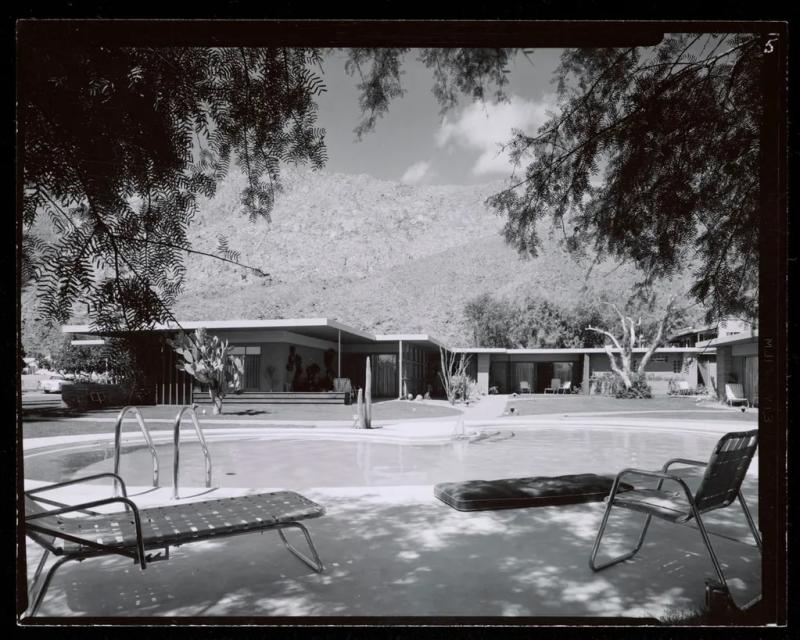
The Four Hundred, 1955, Arenas Road. J. Paul Getty Trust, Getty Research Institute, Los Angeles (2004.R.10)
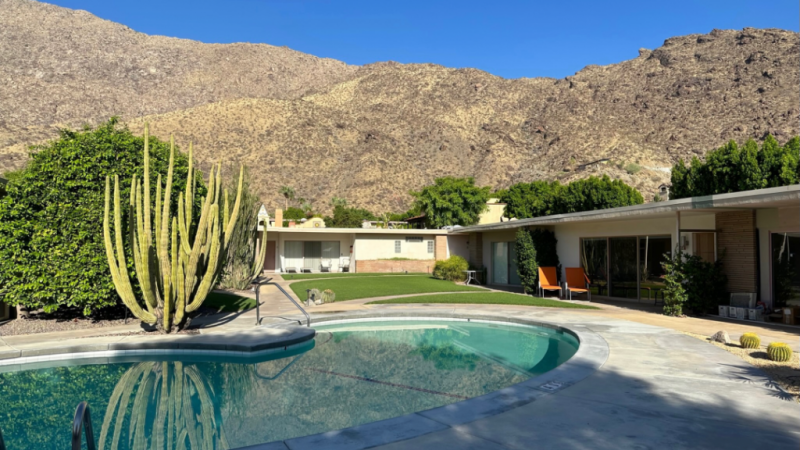
Directions: The Hideaway is next to The Four Hundred.
The Hideaway
370 W Arenas Rd
The Hideaway is a 10-unit apartment hotel, originally opened as The Town & Desert Apartments. It was designed in 1947 and owned by Herbert and Gayle Burns. He believed a house should not be built to impress or show off success, but to be a haven where you can completely relax. The openness of his designs allows people to enjoy the sunshine and fresh air. It was originally configured with five rental units with small kitchens, a larger owner's unit with a guest room, maid's quarters, an office, and a garage. The garage was later converted into a living space.
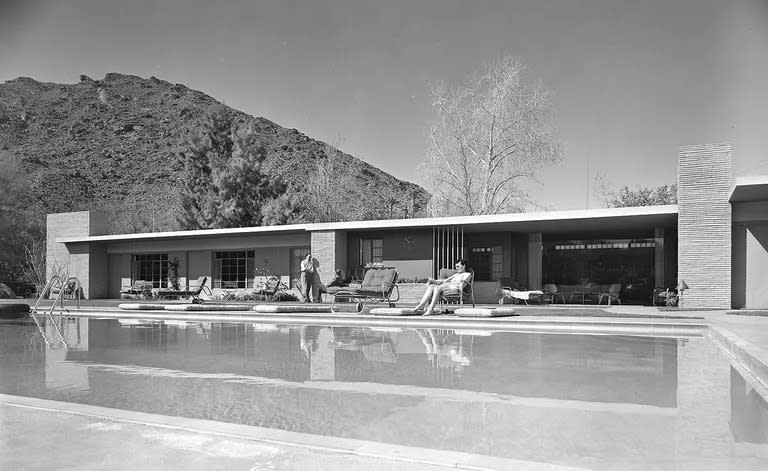
Town & Desert Apartment Hotel, 1947. Arenas Road. J. Paul Getty Trust, Getty Research Institute, Los Angeles (2004.R.10)
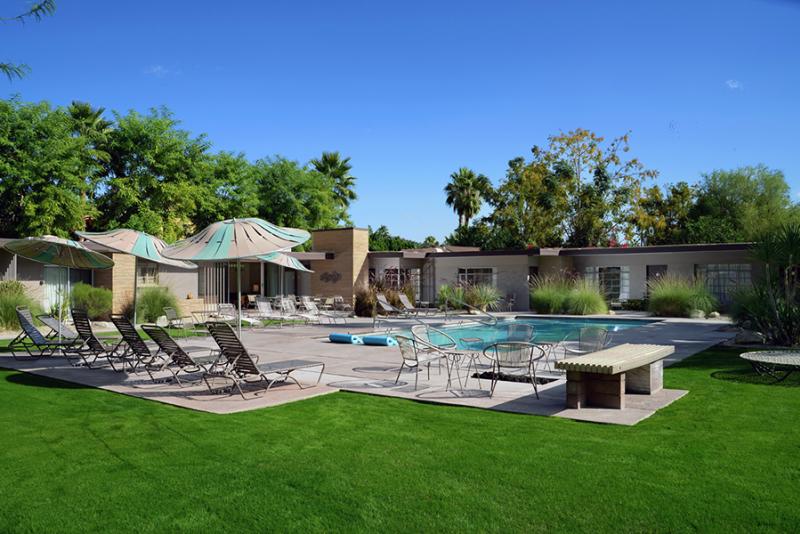
The Story of the Tennis Club Neighborhood
The Historic Tennis Club neighborhood is particularly interesting because several generations of Palm Springs architecture overlap here.
The earliest properties reflect the city's Spanish and Mediterranean influences. By the middle of the 20th century, architects such as Herbert Burns, William Cody, Albert Frey and Paul Williams were introducing increasingly modern ideas about space, materials and indoor-outdoor living.
That evolution mirrors Palm Springs itself.
The neighborhood went from early desert settlement to winter retreat, Hollywood playground and architectural destination—all within a relatively small collection of streets.
Make It a Full Palm Springs Day
The Historic Tennis Club neighborhood sits immediately south of downtown, making it easy to combine this walking tour with other Palm Springs experiences.
After your walk, head downtown for lunch, visit the Palm Springs Art Museum, explore the Palm Springs Architecture and Design Center, or stop for a drink or dinner at one of the restaurants surrounding the neighborhood.
Here is a list of other self-guided tours.
Frequently Asked Questions
How long is the Historic Tennis Club neighborhood walking tour?
The self-guided route is approximately 2 miles and takes about 1½ to 2 hours, depending on how long you spend at each stop.
Where does the Historic Tennis Club neighborhood walking tour start?
The tour can begin near North Museum Drive, across from the Palm Springs Art Museum, where free public parking is available.
Can visitors play tennis at the Palm Springs Tennis Club?
The Palm Springs Tennis Club is a private facility. Visitors should not enter the courts or private areas unless they are members or authorized guests.
What is the Historic Tennis Club neighborhood known for?
The neighborhood is known for its early Palm Springs history, historic homes, boutique hotels, resort architecture, and its connection to Pearl McCallum McManus and the Palm Springs Tennis Club.
Is the Historic Tennis Club neighborhood walkable?
Yes. The neighborhood is well suited to exploring on foot, although summer heat can make walking uncomfortable during the middle of the day. Plan your walk for the morning or late afternoon and carry water.
Explore More: