

By the late 19th century, Palm Springs was still in its earliest phase of transition—a landscape defined more by survival than by destination. Yet within this remote desert setting, one individual would recognize the potential for something more enduring: a place not only to live, but to welcome others.
A Desert Settlement at the Edge of Change
When Welwood Murray arrived in the Coachella Valley in the 1880s, Palm Springs was not yet a town in any formal sense. It was a small, loosely organized settlement situated around the life-giving waters of the hot mineral spring known as Séc-he, long held sacred by the Agua Caliente Band of Cahuilla Indians. For generations, the spring had sustained the Tribe both physically and culturally, anchoring life in an otherwise arid environment.
Non-Native settlement had only recently begun. John Guthrie McCallum, widely recognized as the first permanent non-Native resident, had established a homestead in the 1870s, followed by a small number of additional settlers. These early residents relied on agriculture, ingenuity, and cooperation to survive in a region where infrastructure was minimal, and isolation was a constant reality.
Within this context, Murray’s arrival marked a subtle but important shift. Where others saw a challenging place to endure, he saw the early outlines of a destination.
From Immigrant to Community Builder
Born in Scotland in 1824, Murray brought the perspective of an immigrant who had already adapted to multiple environments across the United States before arriving in Southern California. By the time he settled in Palm Springs, he was experienced, pragmatic, and attuned to the needs of both residents and travelers.
His relationship with McCallum proved particularly significant. The two men shared a belief that the desert, while harsh, possessed qualities that could attract others—namely, its climate, scenery, and perceived health benefits. This shared outlook helped shape the earliest vision of Palm Springs not merely as a settlement, but as a place with broader appeal.
The Palm Springs Hotel and the Birth of Hospitality
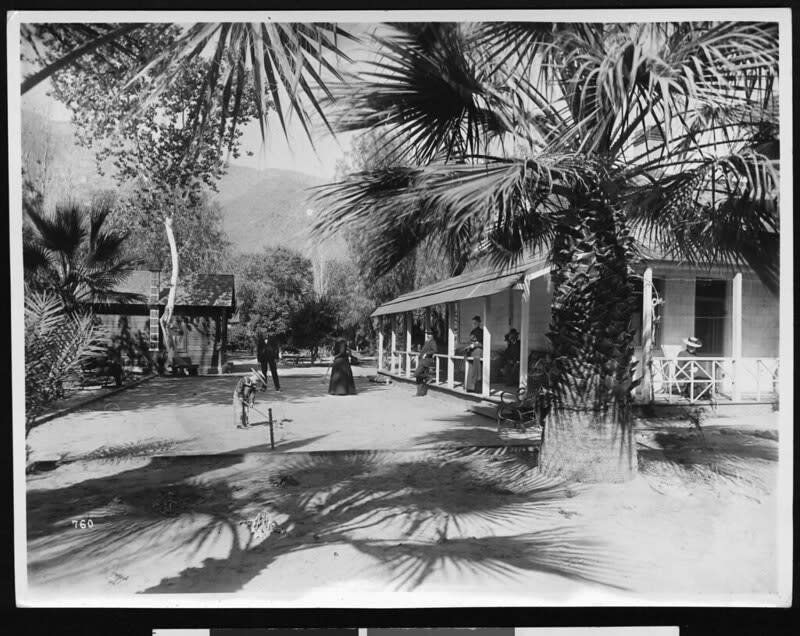
In 1886, Murray translated that vision into action by opening the Palm Springs Hotel, the first commercial lodging establishment in the village. Though modest in scale, consisting of a handful of guest rooms, a communal dining space, and shaded outdoor areas, it represented a turning point in the development of Palm Springs.
For the first time, accommodations were designed specifically for visitors rather than residents. This distinction, while subtle, marked the beginning of a new economic and cultural direction for the community.
Travelers who journeyed to Palm Springs in the late 19th century were often motivated by health concerns. The dry desert air was widely believed to benefit those suffering from respiratory illnesses, and climates like that of the Coachella Valley were increasingly promoted as restorative environments. Murray’s hotel provided these visitors with both shelter and a sense of welcome, transforming what might have been a difficult journey into a purposeful retreat.
Just as importantly, the hotel functioned as a social center. In a small and dispersed settlement, it offered a place where residents and visitors could gather, share meals, exchange news, and form connections. In this way, the Palm Springs Hotel became more than a business; it became one of the earliest communal spaces in the village.
Early Tourism and the Formation of Identity
The presence of Murray’s hotel helped establish a pattern that would define Palm Springs for decades to come. Visitors arrived not for spectacle or luxury, but for atmosphere—sunlight, quiet, mountain views, and a sense of distance from urban life. The experience was informal and personal, shaped as much by the landscape as by the people who inhabited it.
While the scale of tourism remained small during this period, the conceptual shift was profound. Palm Springs was no longer solely a place of settlement; it was beginning to function as a destination. This emerging identity would later be expanded by figures such as Nellie Coffman, but its origins can be traced directly to Murray’s early efforts.
A Lasting Legacy in the Built Environment
Murray remained a respected figure in the community until his death in 1914. His influence, however, extended well beyond his lifetime. In 1940, his son funded the construction of the Welwood Murray Memorial Library, located at the intersection of Palm Canyon Drive and Tahquitz Canyon Way.
The library would go on to serve multiple roles within the city, including housing the archives of the Palm Springs Historical Society and functioning as a cultural and informational hub for both residents and visitors. Its presence in downtown stands as a tangible reminder of Murray’s foundational role in shaping the community.
A Continuity of Place: Cornelia White and the Preservation of Murray’s Legacy
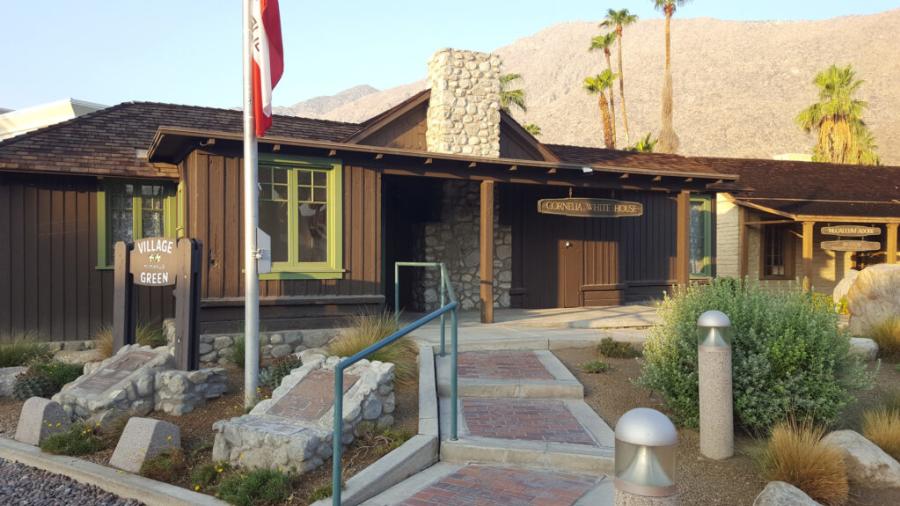
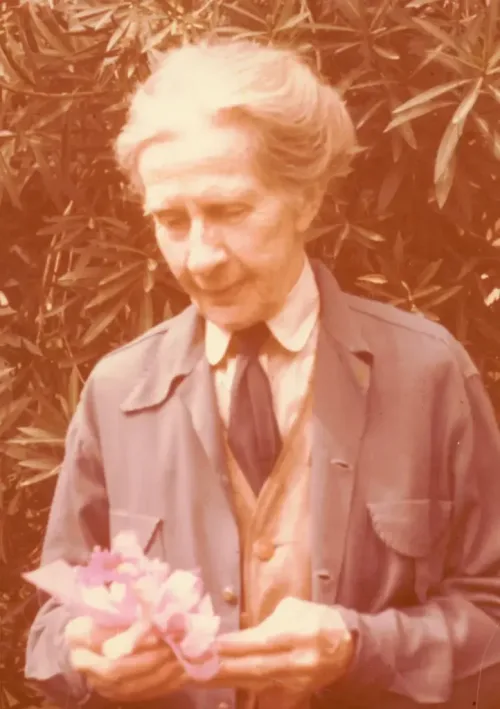
Murray’s influence on Palm Springs did not end with his passing in 1914. That same year, a new chapter began when Cornelia White, an adventurous early settler who had arrived the previous year, purchased the former Palm Springs Hotel property. Among the structures she acquired was the small 1893 bungalow Murray had built from salvaged railroad ties taken from the failed narrow‑gauge Palmdale Railroad project.
White made the humble structure her home, and in doing so, she became the steward of one of the earliest surviving buildings in Palm Springs. Her decision to preserve and inhabit Murray’s railroad‑tie house created a rare continuity between the settlement era and the emerging village that would follow. Decades later, in 1944, she donated the building to the city, ensuring its protection at a time when much of early Palm Springs was rapidly changing.
Today, the Cornelia White House stands beside the McCallum Adobe at the Village Green Heritage Center, physically linking the stories of Palm Springs’ first non‑Native settler (McCallum), its first hotelier (Murray), and one of its most important preservationists (White). Through White’s care, Murray’s presence remains visible in the modern city — not only in memory, but in the built environment itself.
Murray’s Place in Palm Springs History
Welwood Murray was not the founder of Palm Springs in the traditional sense. The deeper history of the land belongs to the Agua Caliente Band of Cahuilla Indians, and the earliest phase of non-Native settlement is closely tied to the McCallum family. Yet Murray occupies a distinct and essential place within this broader narrative.
His contribution lies in recognizing and acting upon a new possibility: that Palm Springs could extend beyond subsistence and become a place of welcome. By establishing the village’s first hotel, he initiated the development of a hospitality tradition that would ultimately define the city’s global identity.
In many ways, the boutique, experience-driven hospitality culture associated with Palm Springs today can be traced back to this moment. Murray’s hotel did not resemble the resorts that would follow in scale or design, but it introduced an idea that would endure—that the desert, far from being an obstacle, could be the very reason people came.
📍 Plan Your Visit
You can explore Murray’s legacy at:
- Welwood Murray Memorial Library — downtown Palm Springs
- Palm Springs Historical Society — home to the McCallum Adobe and Cornelia White House
- Agua Caliente Cultural Plaza — for deeper Indigenous history and context
Related Stories
- Early Palm Springs Pioneers: John Guthrie McCallum
- Palm Springs History
- Agua Caliente Tribe: A Brief History
- Agua Caliente Hot Mineral Springs: A Sacred Legacy of Healing & Culture
- The Birth of Midcentury Modernism in Palm Springs
- The Early Resort Era: How Palm Springs Became a Desert Retreat (1900–1930)