

The story of modern Palm Springs does not begin with development plans or resort architecture. It begins with water, illness, and an encounter between vastly different worlds—one ancient and deeply rooted, the other newly arrived and struggling to survive.
At the center of that early transition stands John Guthrie McCallum, a figure whose motivations were personal rather than speculative, and whose legacy reflects both ambition and limitation within a complex historical landscape.
An Ancient Landscape Meets a New Arrival
When McCallum arrived in the Coachella Valley in the early 1880s, he entered a place that had already sustained human life for thousands of years. The Agua Caliente Band of Cahuilla Indians had long inhabited the region, organizing their community around the hot mineral spring known as Séc-he. This spring was not simply a water source—it was a sacred site, central to cultural identity, seasonal movement, and survival in a desert environment where water defined everything.
By the time McCallum appeared, the pressures of American expansion had already begun to reshape Indigenous life across California. Federal policies, including the reservation system and the allotment of land into checkerboard sections, introduced new legal and spatial structures that would profoundly affect the Agua Caliente people. It was within this shifting context that McCallum established himself—not on empty land, but within a landscape already inhabited, governed, and understood in ways fundamentally different from his own.
A Father’s Decision and the Origins of Settlement
McCallum did not come west in search of gold or land speculation, as many of his contemporaries had. His journey was driven by urgency and hope. His young son, Johnnie, suffered from tuberculosis, a disease that in the 19th century was often treated through climate therapy. Physicians widely recommended dry, warm environments, and Southern California’s desert regions were increasingly seen as potential sites of recovery.
This pattern, families traveling in search of health, would later become a defining characteristic of Palm Springs tourism. In McCallum’s case, it marked the beginning of permanent non-Native settlement in the area.
At 57 years old, McCallum was not a typical pioneer. Born in Tennessee and established professionally in San Francisco, he had already lived a full life before arriving in the desert. His background included work as a lawyer, civic involvement, and a role as an Indian Agent for the Mission Indians—an experience that placed him at the intersection of federal policy and Native communities during a period of profound upheaval.
Vision in a Waterless Landscape
What McCallum recognized almost immediately was that the valley’s potential depended on water. The presence of the hot spring alone was not sufficient to sustain agriculture or long-term settlement at scale. If water could be diverted from the nearby San Jacinto Mountains, specifically from Andreas Canyon, the flatlands could be cultivated.
This insight led to the construction of the McCallum Ditch, an early irrigation channel that carried mountain runoff into the valley. The project required both physical labor and coordination with the local environment, and for a time, it succeeded. The McCallum family established orchards, planted crops, and demonstrated that agriculture in the desert was possible under the right conditions.
Yet the desert imposed its own limits. Periods of drought reduced water flow, while seasonal flooding eventually destroyed the ditch entirely. These events underscored a reality that would shape Palm Springs for decades: development in the desert required not only vision but resilience in the face of environmental instability.
The Formation of a Small Community
Despite these setbacks, McCallum’s presence helped anchor a small but growing non-Native community. His homestead became a focal point for early settlement, and other arrivals—drawn by similar hopes of health, opportunity, or climate—began to appear.
Among them was Welwood Murray, whose partnership with McCallum would prove significant. Where McCallum focused on land and agriculture, Murray recognized the emerging potential for hospitality. In 1886, he opened the Palm Springs Hotel, the village’s first formal lodging establishment, marking the earliest step toward a tourism-based economy.
Together, their efforts represent two complementary visions: one rooted in sustaining life in the desert, the other in welcoming others into it.
The McCallum Adobe and Material Memory
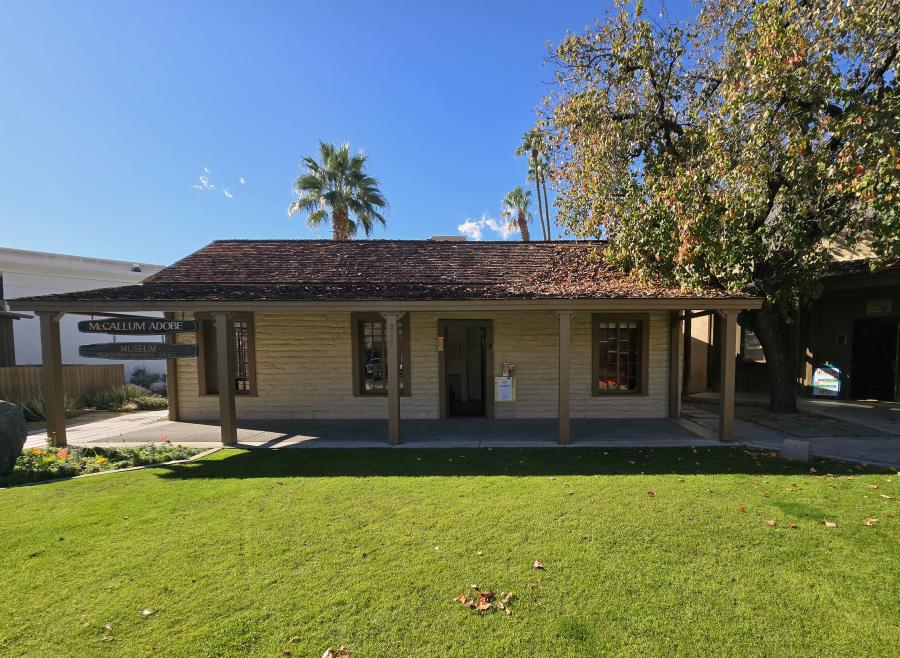
In 1884, McCallum constructed what is now known as the McCallum Adobe, the oldest surviving structure in Palm Springs. Built from sun-dried adobe bricks, the home reflected both practicality and adaptation to the desert environment, offering insulation against heat and cold.
Today, the adobe forms part of the Village Green Heritage Center and is preserved by the Palm Springs Historical Society. It serves as a rare physical link to the earliest period of settlement, offering insight into daily life, material conditions, and the scale of the original village.
Through artifacts, photographs, and archival records, the site provides a tangible connection to a time when Palm Springs consisted of little more than a handful of structures clustered around water and survival.
Family, Legacy, and Continuity
McCallum’s influence extended through his family, particularly his daughter, Pearl McCallum McManus. Arriving in the desert as a child, Pearl would go on to play a central role in shaping Palm Springs during the early 20th century. Her contributions to civic life, philanthropy, and development bridged the gap between the settlement era and Palm Springs's rise as a recognized destination.
Her writings provide some of the most detailed firsthand accounts of early village life. She described a quiet landscape marked by sandy roads, sparse structures, and close proximity between settlers and the Agua Caliente community—an environment defined as much by isolation as by cooperation.
Positioning McCallum in History
It is essential to understand McCallum’s role with precision. He was not the founder of Palm Springs in any absolute sense; the land's history extends far beyond his arrival, rooted in the longstanding presence of the Agua Caliente Band of Cahuilla Indians.
Rather, McCallum represents the beginning of a new chapter—the introduction of permanent non-Native settlement within an already inhabited landscape. His efforts illustrate both the possibilities and the constraints of that moment: the ambition to reshape the desert, and the realities imposed by environment, infrastructure, and existing communities.
Legacy in a Changing Desert
John Guthrie McCallum died in 1897, having spent little more than a decade in the desert. Yet within that relatively short period, he helped establish patterns that would define Palm Springs’ future: the pursuit of health through climate, the importance of water infrastructure, and the gradual emergence of a community shaped by both necessity and vision.
His story, when viewed alongside those of Welwood Murray and later figures like Nellie Coffman, reveals the layered progression of Palm Springs—from Indigenous homeland to fragile settlement, and eventually to a destination known around the world.
What began as a father’s attempt to save his son’s life became, in time, part of a much larger narrative: the transformation of a desert landscape into a place where people continue to seek healing, rest, and renewal.
📍 Plan Your Visit
Explore early Palm Springs history at:
- McCallum Adobe — Palm Springs Historical Society
- Village Green Heritage Center
- Cornelia White House
- Welwood Murray Memorial Library
- Agua Caliente Cultural Plaza
Related Stories
- Palm Springs History
- Agua Caliente Band of Cahuilla Indians: A Historical Overview
- Agua Caliente Hot Mineral Springs: A Sacred Legacy of Healing & Culture
- Explore the Rich Heritage of the Agua Caliente Cahuilla Indians
- The Birth of Midcentury Modernism in Palm Springs
- The Early Resort Era: How Palm Springs Became a Desert Retreat (1900–1930)