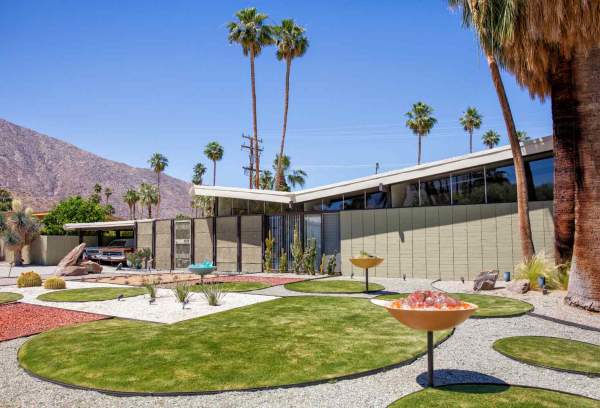
Midcentury Modern Architecture, Desert Adaptation, and Postwar Innovation
Archibald Quincy Jones, commonly known as A. Quincy Jones, was a Los Angeles-based architect whose work helped define midcentury modern architecture in Southern California, including several notable projects in Palm Springs. Educated at the University of Washington, where he graduated with a degree in architecture in 1936, Jones began his professional career in Los Angeles at a moment when modernism was reshaping American residential and commercial design.
From 1939 to 1940, Jones worked under the influential architect Paul R. Williams, a relationship that would later evolve into direct collaboration on multiple Palm Springs commissions. This early professional partnership exposed Jones to both high-profile residential clients and large-scale commercial projects, shaping his approach to architectural refinement, site planning, and climate responsiveness.
Between 1942 and 1945, Jones served in the United States Navy, interrupting his architectural career during World War II. Upon returning to civilian life, he reopened his practice in Los Angeles under the name A. Quincy Jones & Associates, quickly establishing himself as one of the region’s most respected modernist architects.
In 1969, the firm received the American Institute of Architects Architectural Firm Award, one of the profession’s highest honors, recognizing “overall achievement in architecture.” Individually, Jones earned more than 70 citations for excellence, reflecting both peer recognition and the breadth of his influence across residential, commercial, and institutional architecture.
Beyond practice, Jones was deeply involved in architectural education. From 1951 to 1967, he served as a professor and later dean at the University of Southern California School of Architecture, where he influenced a generation of architects during a pivotal era of postwar expansion and experimentation.
Design Philosophy and Architectural Legacy
A. Quincy Jones played a central role in redefining the California tract house, transforming it from a purely utilitarian product into a thoughtfully designed structure integrated with its surrounding landscape. His work emphasized logical planning, environmental sensitivity, and informal living, principles that aligned naturally with the evolving lifestyle of postwar Southern California.
Jones’ architecture was particularly responsive to desert climates. He became an early expert in passive design strategies, incorporating wide roof overhangs to provide shade during the intense summer months while allowing solar heat gain during the lower winter sun. His use of turned-down eaves, deep canopies, and vertical louvers, particularly on west-facing façades, mitigated heat gain during late-afternoon exposure, techniques that predate later sustainability movements.
Attention to siting, detail, and mechanical integration distinguished Jones’ larger projects. Rather than treating mechanical systems as secondary necessities, he integrated them into the architectural logic of his buildings, ensuring efficiency without sacrificing aesthetics. These strategies positioned his work as exemplary within the broader canon of midcentury American architecture.
Palm Springs Projects and Contributions
Palm Springs Tennis Club Addition (1947)
701 W Baristo Road
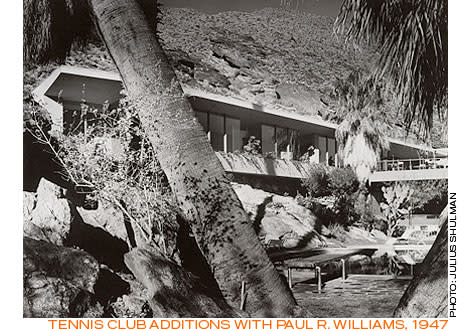
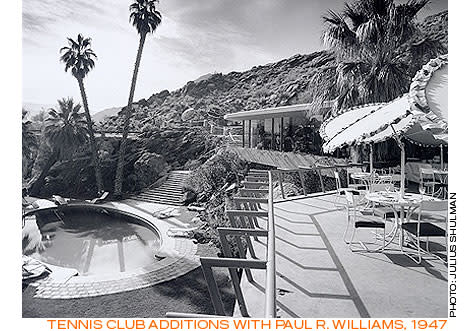
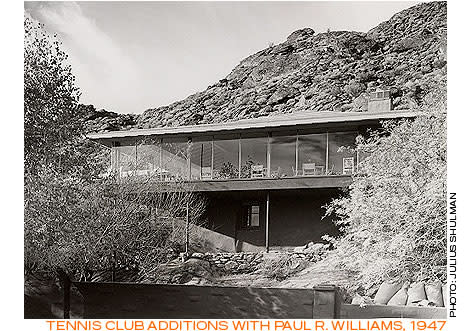
Originally developed by Palm Springs pioneer Pearl McManus, the Tennis Club was one of the city’s earliest social and recreational institutions. In the late 1940s, McManus commissioned Paul R. Williams and A. Quincy Jones to design a major expansion.
Their joint design transformed the club from an Amalfi-inspired, monastery-style property into a modern desert-responsive complex. The additions emphasized solid architectural volumes, extensive use of natural wood and stone, unpainted brick, and wraparound glass that dissolved the boundary between interior and exterior spaces.
The renovation expanded dining, swimming, and tennis facilities. It introduced new social spaces, including the Bougainvillea Room, a cocktail lounge, a snack bar, outdoor dining terraces, and lawn areas for lounging and sunbathing. The project stands as an early example of collaborative modernism in Palm Springs, blending elegance with climate-driven design.
Town & Country (1948)
169 N. Indian Canyon
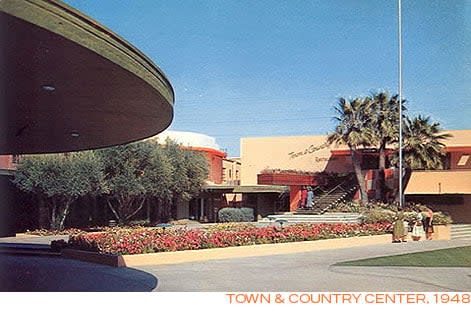
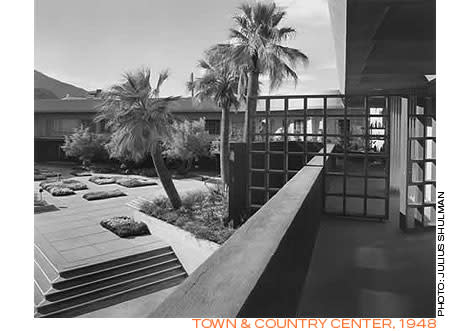
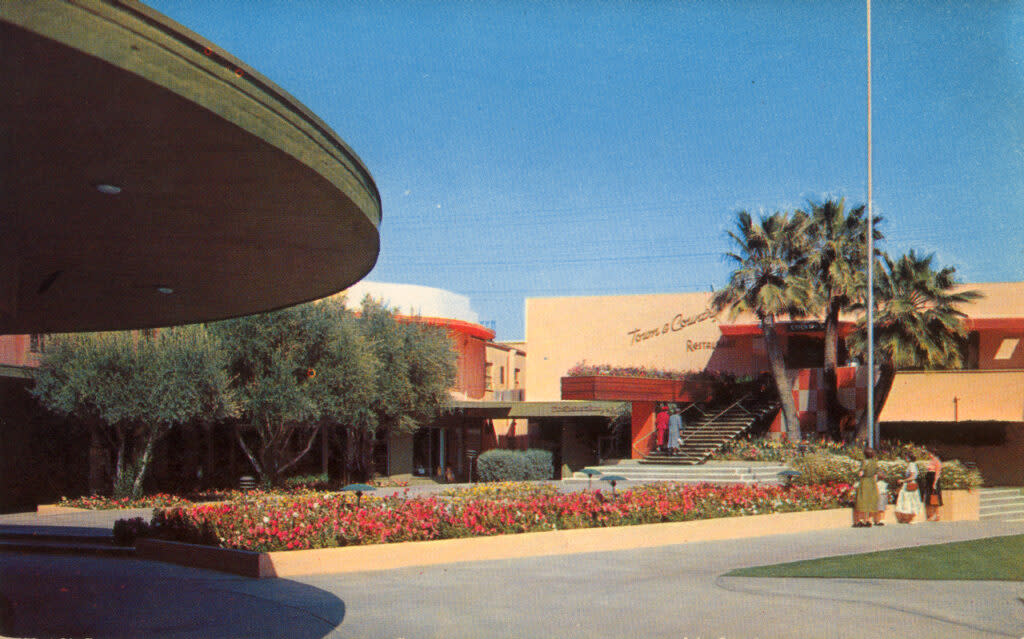
Originally opened as “The Center,” the Town & Country complex was constructed in multiple phases on land owned by the Bank of America. Designed by A. Quincy Jones and Paul R. Williams, the project introduced a large interior courtyard spanning Palm Canyon and Indian Canyon Drives, an urban sanctuary intended to encourage gathering and movement.
Architecturally, the complex is a significant example of International Style modernism, emphasizing volume over mass. The west façade features a semi-circular structure with faceted plate glass, pronounced horizontal overhangs, and a floating staircase rising from an asymmetrical platform.
The project’s success prompted continued redevelopment of the surrounding block through 1955, with additional architectural contributions by Albert Frey, John Porter Clark, Donald Wexler, and Richard Harrison. In April 2016, the Town & Country Center was designated a Class 1 Historic Site.
Bank of America (1949)
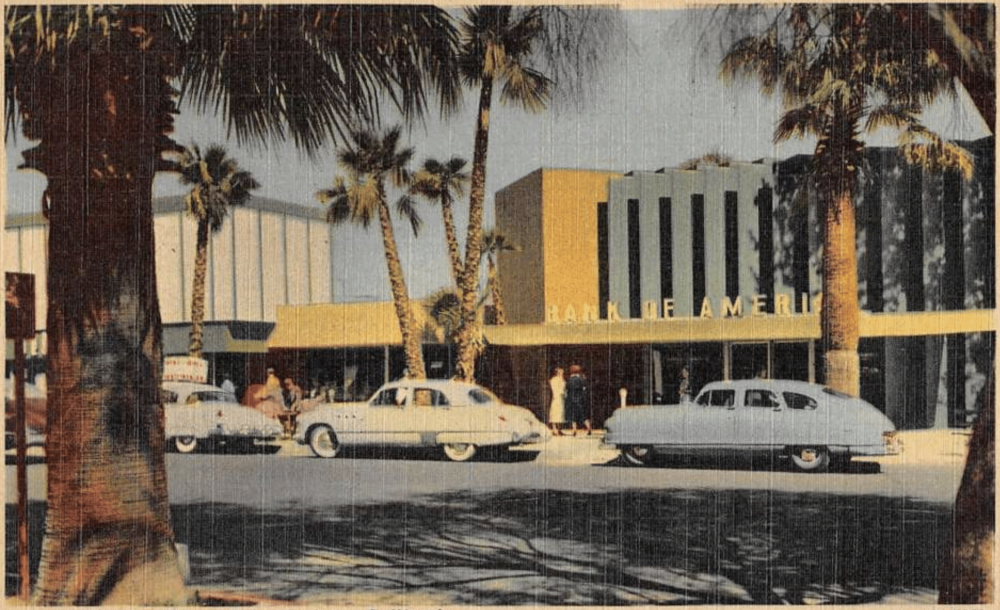
146-150 North Palm Canyon Drive
Designed by Paul R. Williams and A. Quincy Jones as part of the Town & Country complex, this structure originally housed banking facilities and now functions as retail space. Its restrained modernist detailing complements the complex's broader composition.
The Jerome J. Robinson House (1957)
999 North Patencio Road
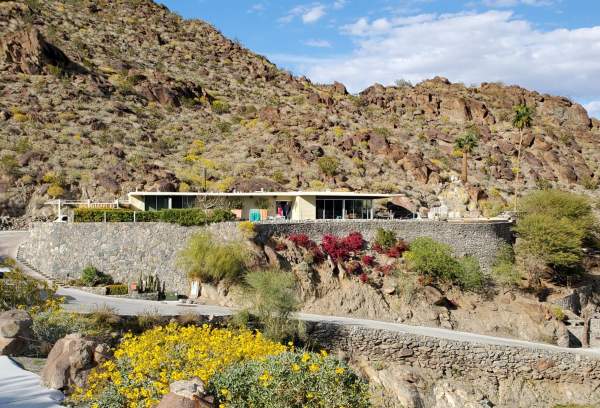
This 6,307-square-foot residence exemplifies Jones’ mastery of residential design. Featuring wide protective overhangs, a deeply recessed entrance, and a signature canopy, the house balances privacy with openness. An interior garden separates the lounge and dining areas, reinforcing Jones’ commitment to spatial flow and indoor–outdoor living.
The home gained pop-culture recognition through its appearance in the film Ocean’s 11.
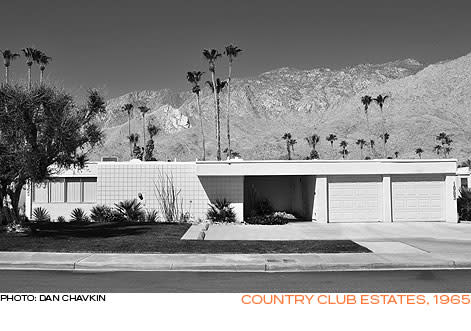
Country Club Estates Condo (1965)
La Vern Way, South Camino Real
This low-density complex of 30 midcentury modern residences occupies a 4.6-acre site in South Palm Springs. Many units adopt U-shaped configurations centered on private courtyards, while concrete block walls filter light and air, reinforcing environmental integration.
Demolished Works
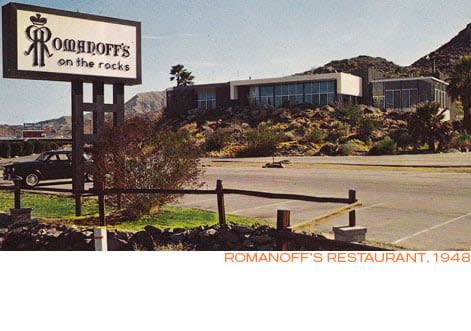
Romanoffs on the Rocks (1950)
67399 E. Palm Canyon (Highway 111)
Designed by A. Quincy Jones and Frederick Emmons, this high-profile restaurant later became the nightclub Pompeii, which closed in 1962. The structure was ultimately destroyed by arson, representing a significant loss to Palm Springs’ midcentury architectural heritage..
This article is part of the ongoing series, "Architects Who Built Palm Springs," which explores the designers whose visions transformed a desert town into a modernist landmark.